A kitchen water filter isn't an automatic upgrade for every Melbourne home, and a concern about PFAS doesn't, by itself, mean you need to buy one. The right choice depends on why you want filtered water: to improve taste or odour, to catch sediment, to suit an appliance, or to treat a contaminant that testing has identified. Choose the wrong system, or fail to maintain the one you install, and you can spend money without solving the problem.
For most homes on Melbourne's regulated mains supply, filtration is a point-of-use decision rather than a replacement for public-water treatment. Start with the reason you're considering a filter, then check that the system is designed, certified and maintained for that purpose.
Why Melbourne Kitchens Consider a Water Filter
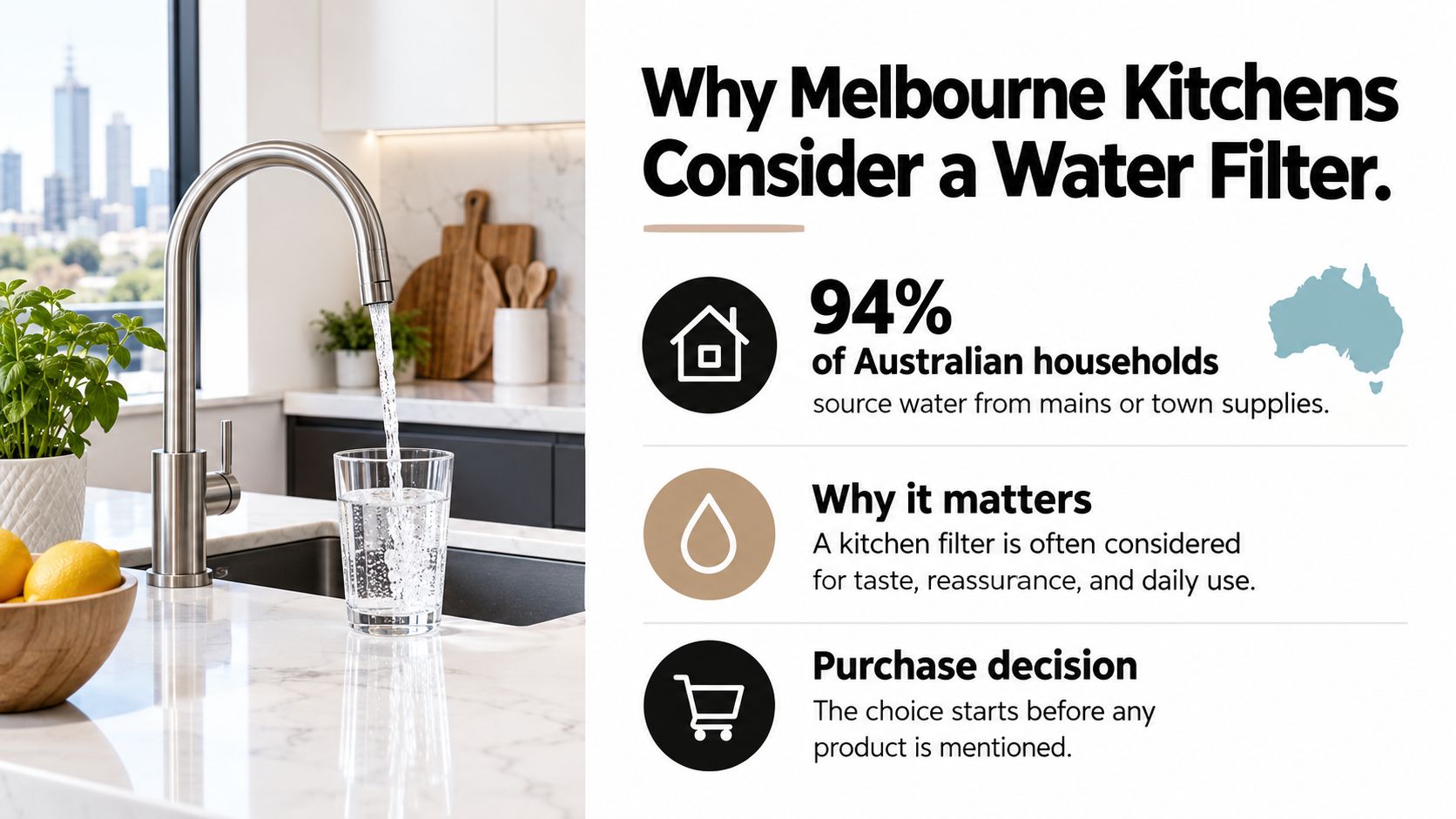
Does every kitchen need a filter? The available household figures don't support that assumption. In 2019–20, 94% of Australian households sourced water from mains or town supplies, according to the Australian Bureau of Statistics household water-use data. Earlier figures show that mains water was already widely used: in March 2007, 93.4% of households reported it as a water source.
Satisfaction varied. Among mains-water households in 2007, 77.2% were satisfied with mains-water quality, while 18.5% were dissatisfied. In 2004, taste other than salinity was the most commonly identified problem among people dissatisfied with their drinking water. Those figures help explain why many people consider filters for everyday preference, not because a filter is automatically required for health protection.
Two different reasons to filter
Preference-based filtration is about the experience of using water. You might want to reduce chlorine taste or odour, catch visible sediment, or feel more comfortable drinking from the tap. If you're pairing filtered water with a boiling or chilled unit, you may also be thinking about the appliance's supply and day-to-day performance.
Verified-contaminant filtration is different. It starts with a specific concern, such as a test result or relevant water-quality advice, and calls for a system shown to reduce that contaminant. A filter sold as “multi-stage” or “premium” isn't proof that it can do so.
Household filter use has varied by jurisdiction. The ABS data on household water filters reports that in 2007 South Australia had the highest state or territory rate, at 38.4%, while the Northern Territory recorded 14.1%. That variation is another reason not to treat kitchen filtration as a universal requirement.
Start with the problem, not the product. If the issue is taste, choose a system with relevant aesthetic performance claims. If you're addressing a contaminant, confirm the exact contaminant and look for independent performance evidence for it.
If hard water is part of your concern, separate that issue from drinking-water taste or contaminant treatment. This guide to water hardness in Melbourne can help you understand what a filter may, and may not, address.
The Main Types of Kitchen Water Filter Explained
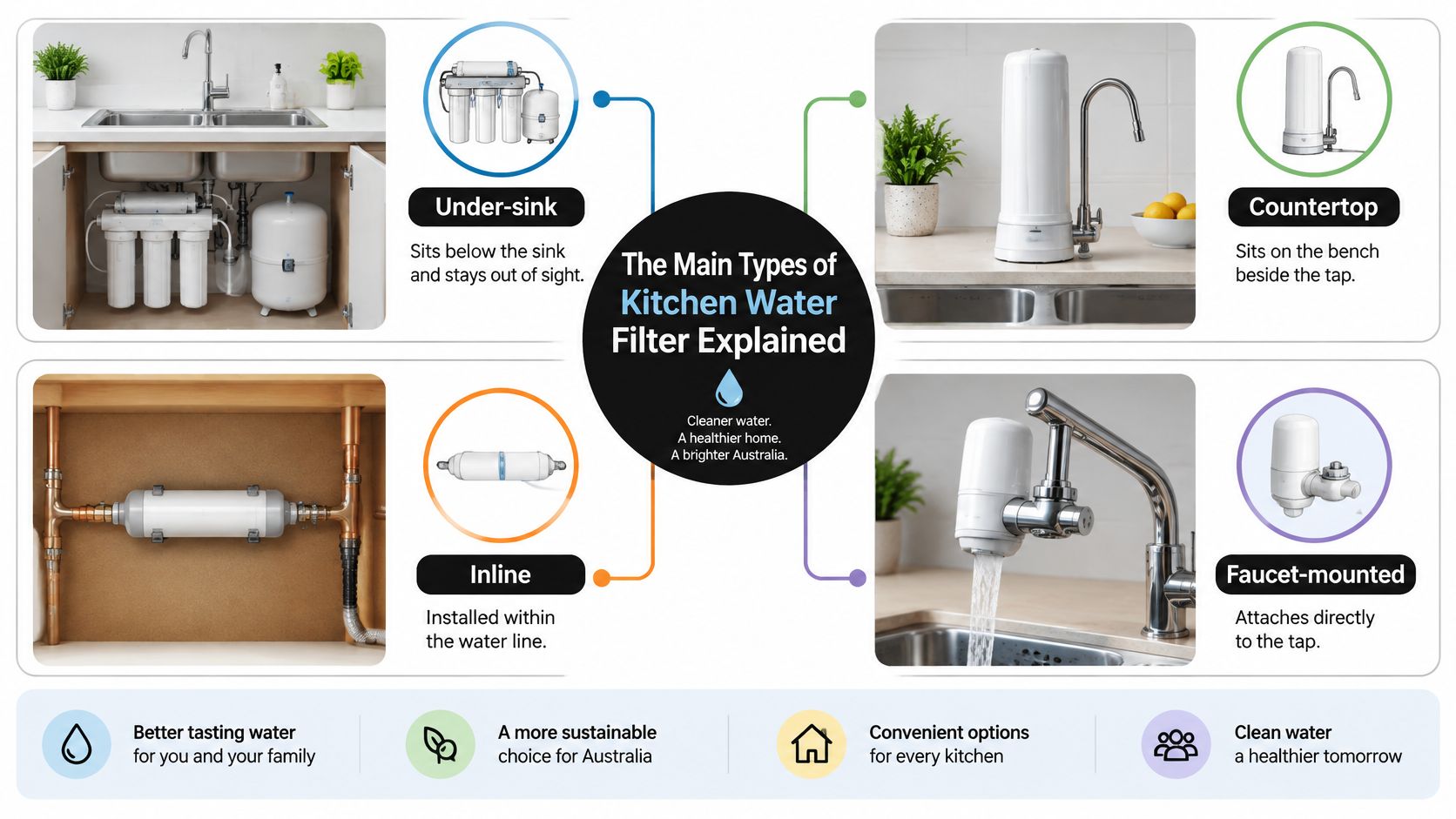
Filter type describes where the unit sits and how you'll live with it. It doesn't, on its own, tell you what the filter removes. Match the layout to your kitchen, then verify the treatment claims for the actual cartridge and system.
Choose by placement and access
An under-sink system keeps its housing inside the cupboard and supplies a dedicated drinking-water tap or a compatible appliance. It suits a homeowner who wants a clear bench and is already planning a boiling or chilled tap. The trade-off is visibility: once the cupboard door is shut, a cartridge or leak can be easy to forget unless maintenance is scheduled.
A countertop filter sits beside the sink and is usually straightforward to reach when it needs attention. That can suit a renter or someone who doesn't want work inside the cupboard, but the unit takes up bench space and is part of the kitchen's everyday clutter. Check how it connects to the tap and whether the arrangement will suit your sink.
An inline filter is installed in a particular water line, such as the supply to a fridge or a single tap. It's a focused option when you want to treat water for one appliance rather than the whole kitchen. That focus also limits its usefulness elsewhere: the other taps won't receive filtered water unless they're connected to the system.
A faucet-mounted unit attaches directly to the tap. It's a simple entry point for someone who wants a compact, accessible option, but its cartridge capacity and flow need to suit how often the household uses it. Check that the device fits your tap before ordering.
There's no best layout for every household. For taste or odour, a countertop or faucet-mounted system may be enough if its certified performance matches your goal. If you're treating a verified contaminant or supplying a boiling or chilled unit, look beyond convenience and confirm the filter's tested performance, rated flow and installation requirements.
How Filtration Media Actually Remove Contaminants
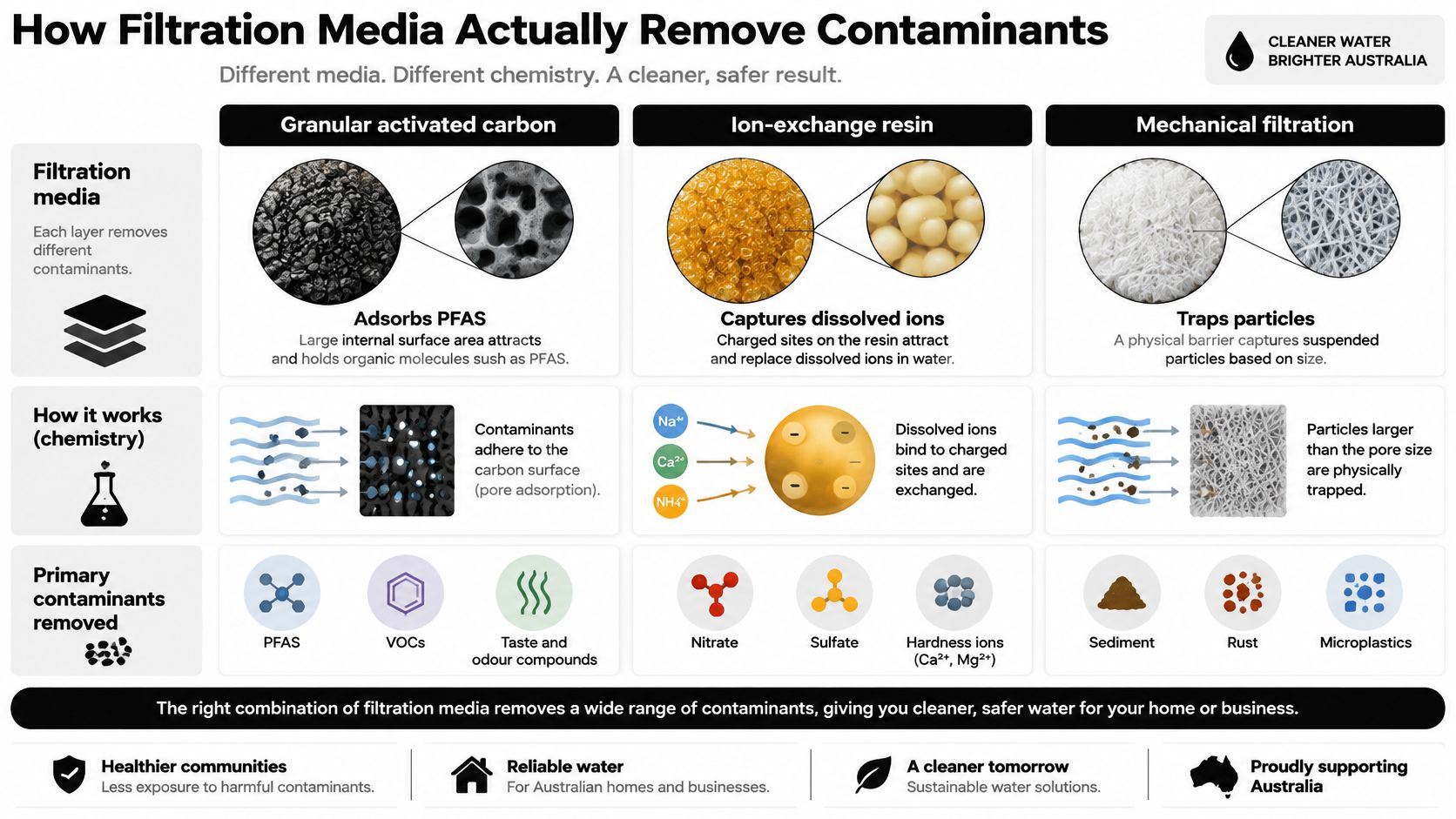
A filter's media determines what it can reduce, while its housing determines where it fits. More stages do not automatically mean better treatment. Check what each stage is designed to do and whether the complete system has evidence for the contaminant you want to address.
Match the mechanism to the target
Granular activated carbon can adsorb PFAS when the specific cartridge has been tested for it. Adsorption occurs when compounds attach to the media's surface. Carbon is also used to improve taste and odour, but a generic carbon cartridge does not prove PFAS reduction. Look for test results or certification that name the relevant PFAS compounds.
Ion-exchange resin captures certain charged substances. Its performance depends on the resin type and system design, so check that the product's evidence covers the substance you want to reduce.
Reverse osmosis uses pressure to push water through a membrane. It works differently from carbon and ion exchange, and its suitability depends on the target contaminant and the system's documented performance.
The Water Services Association of Australia's PFAS drinking-water guidance cites Australian health-based guideline values of 70 ng/L for PFOS and PFHxS combined, and 560 ng/L for PFOA. These are health-based values, not proof that a particular filter will reduce those compounds. Check independent testing or certification for the specific cartridge and confirm its replacement schedule.
Media have a finite treatment capacity. As a cartridge approaches the end of its rated life, its ability to capture contaminants can decline. Replace it according to the manufacturer's capacity and maintenance instructions.
A point-of-use filter may also reduce chlorine, which contributes to the disinfectant residual in the water supply. Some treatment systems can reduce fluoride too. Choose filtration for a defined taste, odour or contaminant concern rather than assuming every household needs the same treatment. For a closer look at how ceramic media are used in filters, see this guide to a ceramic water filter cartridge.
Comparing Flow Rates, Capacity and Maintenance Burden
A filter can perform well on paper and still be the wrong choice if it restricts the appliance it supplies. A drinking-water tap and a boiling or chilled unit may have different supply requirements, so compare the filter's rated flow and pressure with the downstream appliance's specifications before you buy.
The table is a comparison framework, not a set of product specifications. Typical flow and cartridge capacity vary by model and media, so use the manufacturer's figures rather than treating a filter category as a rating.
Compare the practical fit
| Filter type | Placement | Typical flow | Cartridge capacity | Maintenance access | Best fit |
|---|---|---|---|---|---|
| Under-sink | Cupboard below sink | Check against appliance requirements | Check rated capacity and replacement interval | Hidden; allow access and fit an isolation valve | Dedicated drinking tap or compatible boiling or chilled unit |
| Countertop | Bench beside tap | Check model specifications | Check cartridge rating and household use | Easy to see and reach | Bench space available, straightforward servicing preferred |
| Inline | Within one water line | Check the appliance's minimum supply requirements | Check the cartridge rating for that line | Depends on where the unit is installed | Treating a fridge or one specific tap |
| Faucet-mounted | Attached to tap | Check model specifications and tap compatibility | Check the cartridge rating and replacement instructions | Visible and generally accessible | Simple point-of-use setup for a compatible tap |
Shortlist against your appliance
Start with the appliance's rated flow and pressure. If the filter restricts supply below what the unit needs, the result may be slow filling or poor operation. Don't assume a filter is compatible because its fittings physically connect.
Next, compare capacity in litres and the stated replacement interval. Think about your actual household use, not the largest capacity number on the shelf. A cartridge sized for much higher consumption may be unnecessary, while a low-capacity option could mean more frequent replacements in a busy kitchen.
Finally, consider maintenance access. A cartridge behind stored items in a crowded cupboard is more likely to be overlooked than one that's easy to reach. An isolation valve makes servicing more practical because cartridge changes don't need to shut down the whole kitchen supply.
A sound shortlist is one that meets the appliance's flow and pressure requirements, has a capacity suited to real use, and can be serviced on schedule. If a manufacturer won't provide those details, don't fill the gap with guesswork.
Certifications and Installation Checks That Matter
A filter can be safe to install without being proven to remove the contaminant you're concerned about. Treat material-contact safety, plumbing certification and treatment performance as related but separate checks.
Read the certification, not the slogan
AS/NZS 4020 assesses whether materials that contact drinking water adversely affect water quality. That matters for the parts water touches, including the filter housing, tubing, tap and fittings. A product listing that mentions suitable materials is not the same as verifying the relevant documentation.
For the treatment unit, Queensland Health guidance recommends checking for WaterMark or Plumbing Safety Type Test Mark certification and performance compliance with AS/NZS 4348 or NSF/ANSI 53. Those are performance-related checks; they don't replace the material-contact question. The AS/NZS 4020 standard listing describes the standard's role in assessing products that come into contact with drinking water.
Before buying, check the complete wetted assembly, not just the cartridge or one component. Confirm the rated flow and pressure work with the appliance, and verify that the stated reduction claim covers the contaminant you want treated.
Check the installation before ordering
Under-sink systems need enough room for the housing and cartridge changes. If the filter will supply a boiling or chilled tap, make sure the plumbing layout and product specifications suit that appliance. A plumber planning a renovation may also find this resource on planning your kitchen plumbing rough-in useful for thinking through service access and connections before the cupboards and benchtop are finished.
Installation check: Fit an isolation valve so cartridge changes don't require shutting off the whole kitchen supply. Confirm its location and accessibility with the installer.
Finally, read the manufacturer's capacity and maintenance instructions before committing. A “multi-stage” label tells you how a product is described, not whether it meets your performance requirement. Certification, installation compatibility and a realistic service plan should all line up.
What a Kitchen Water Filter Really Costs to Own
The purchase price is only one part of the cost. A filter's ongoing expense depends on its cartridge replacement cycle, any professional servicing, and whether the system adds water or energy demands. Compare quotes on the same basis, rather than choosing by the lowest sticker price.
Build a like-for-like comparison
For each system, record the initial hardware cost and the price of its replacement cartridges. Then note the stated cartridge capacity, the replacement interval under your expected use, and whether a technician is needed for installation or routine servicing. If the system supplies a boiling or chilled unit, check whether its specifications affect the supply or setup.
This gives you a practical ownership estimate. You don't need an invented average to compare products: ask suppliers for their current hardware and cartridge prices, then use the manufacturer's capacity and maintenance instructions to estimate how often you'd replace each cartridge.
A low-cost unit may not remain the cheaper option if its cartridge needs more frequent replacement. Conversely, a larger-capacity system can be poor value if your household won't use enough water to justify that capacity. Compare the cost of cartridges over the same expected period, and make sure you're comparing filters with the same treatment purpose.
Include the cost of neglect
A filter that isn't replaced on schedule may no longer deliver the performance you bought it for. A blocked cartridge can also restrict flow, and an inaccessible unit is more likely to be forgotten. The eventual cost may include troubleshooting or a service visit, but the more important trade-off is having a system that no longer suits its intended job.
Ask whether replacement cartridges are readily available and whether you can change them yourself. If professional service is part of the product's maintenance plan, include that in your comparison. A useful quote should make it possible to see the system, the replacement parts and the servicing responsibilities, rather than leaving those costs vague.
The sensible choice is not automatically the cheapest filter or the one with the longest claimed capacity. It's the system whose verified performance, consumables and maintenance burden fit the water use and appliance you have.
Maintenance Mistakes That Make Water Quality Worse
A filter installed during a renovation can disappear from view. Years later, the boiling tap it supplies may run slowly, and the water may taste flat. Without a service record, the homeowner may not know whether the cartridge is overdue, blocked or still delivering the treatment it was selected for.
Victorian Health guidance warns that filters need regular maintenance and replacement. If they aren't maintained, bacteria can grow on the filter and be released into the filtered water. Greater Western Water also notes that Melbourne's largely unfiltered supply can contain harmless fine or suspended particles that build up on domestic filters, causing blockages and restricting flow.
A routine that prevents avoidable problems
Keep a simple record tied to the actual product instructions, not a generic reminder that assumes every cartridge lasts the same amount of time.
- Track capacity and dates: Follow the manufacturer's rated capacity and replacement interval. Record cartridge changes where the next household member or service technician can find them.
- Check after shutdowns: If the filter or appliance has been unused, follow the manufacturer's guidance for bringing it back into service. Don't assume that a long idle period is irrelevant.
- Flush after replacement: Use the cartridge manufacturer's instructions for flushing. This helps clear the system after a cartridge change.
- Inspect for leaks and flow changes: Check visible connections and watch for unexpected drips, reduced flow or a change in taste. A hidden under-sink unit still needs a deliberate check.
- Assign responsibility: Decide who orders cartridges and who changes or services them. In an office or venue, don't leave that job to whoever happens to notice the tap running slowly.
A neglected filter isn't automatically safer because it's still connected. It may become a maintenance and performance problem, particularly when hidden in a cupboard or paired with an appliance used intermittently. This guide to water filter servicing can help you plan a maintenance arrangement.
Private or bore supplies need a different decision process from regulated metropolitan reticulated water. If you use a private source, base treatment on the relevant testing and water-quality advice rather than assuming a domestic cartridge will address every issue.
Choosing the Right Filter for Your Home, Office or Venue
For a Melbourne homeowner seeking better taste or less odour, choose a system with performance claims that match that preference and a cartridge you can maintain. If you're treating a verified contaminant, confirm the test result, the treatment mechanism and the independent evidence before buying.
An office manager supplying a boiling unit should start with the appliance's flow and pressure requirements, then check the filter's capacity and service access. Hospitality venues should also consider who will maintain the system and how quickly they can arrange cartridges or service if the supply slows.
Ring Hot Water supplies and services under-sink boiling taps, wall-mounted boilers, commercial water chillers and hot water urns, alongside drinking-water filtration systems, genuine spare parts and fittings. Its supported brands include Zip, Stiebel Eltron, Birko, Insinkerator and Robatherm.
Make the purchase decision in order: identify why you want filtration, verify the system's certification and performance for that purpose, then check flow, pressure and maintenance access. Once those details are clear, arrange an assessment or order the compatible cartridge and fittings.
For a kitchen water filter that needs to work with a boiling or chilled tap, Ring Hot Water can help you check the appliance, filtration system and service requirements together. Visit Ring Hot Water to review kitchen filtration options, arrange Melbourne service or find the correct replacement parts.