It's late morning in a Melbourne office kitchen. The kettle has just clicked off, three people are queued at the chilled tap, and the third glass comes out closer to lukewarm. Someone says the unit must be too small. Often the tap isn't the weak point. The stored cold behind it is.
A water chiller tank is the vessel that holds drinking water after it has been cooled, so a short rush doesn't depend on the compressor catching up while you stand there. By the end of this guide you'll know whether you need that storage at all, how cold is cold enough for the way you draw water, and why a bigger vessel isn't automatically the better buy. Two jobs sit side by side: a cold glass when someone wants it, and control of the water that sits between those drinks.
What a Water Chiller Tank Actually Does
Think of a busy Sunshine cafe just after the lunch rush, or a household sink on a hot Saturday when everyone wants a cold drink at once. The mains tap is still flowing. It just can't stay cold, because each new litre arrives at whatever temperature the street supply happens to be that day. The dispenser is only the last step. The tank is the part that has already done the waiting.
You already know this idea from a boiling tap. The small tank under the bench holds hot water so you don't boil a kettle for one cup. A chiller flips that. Instead of banking heat, it banks cold. An under-sink unit, a wall dispenser, or a commercial servery chiller all rely on the same trick: cool a volume in advance, then let people draw it faster than the refrigeration circuit can chill a fresh stream in real time.
Comfort at the glass, control in the vessel
Those are different tests, and they get confused all the time.
The glass test is simple. Does the drink feel cold at the moment someone wants it, without a long wait and without the compressor roaring through every conversation?
The vessel test is quieter. Is that stored water staying cold, moving often enough that it doesn't sit stale, and sitting in a place a plumber can service?
A bigger tank can win the first test and fail the second. Extra volume covers a longer queue, but it also means more water sitting still if the venue is quiet on Mondays, and more surface for heat to creep back in if the cupboard is warm. A tiny tank can look efficient on a label and still run almost nonstop once inlet water is warm and people keep drawing.
Practical rule: Judge the tank by the busiest ten minutes you actually have, not by the coldest glass you got when the kitchen was empty.
You don't need a brand list to make that call. You need a clear picture of peak draw, where the vessel will live, and who will check it after the installer has left. The next sections separate the machine, the sizing choice, the kind of day you run, the site rules, and the upkeep that keeps stored water honest.
Inside the Tank and How Cooling Works
Treat the unit like an esky that is re-chilled whenever the temperature drifts, not like a pipe that is only cold while water is moving. Water sits. Heat tries to get back in. A refrigeration circuit pulls that heat out again, and insulation slows the return trip.
The path from mains to glass
Follow one litre in order.
- Incoming mains water enters from the building's drinking supply. It isn't chilled yet. On a hot week it can arrive noticeably warm, so the machine starts behind.
- The storage vessel holds a ready volume. On prefabricated tanks, a float or level control stops the vessel overfilling as people draw water and new mains water replaces it.
- The refrigeration circuit removes heat. A compressor and its heat-rejection side dump that heat into the room or a condenser airstream. A thermostat or setpoint decides when the compressor starts and stops.
- Insulation wraps the vessel and should continue along nearby pipework. Bare metal in a hot cupboard gives back the cold you just paid for.
- The chilled water outlet is the tap, bubbler, or dispenser. Valves, hoses, and fittings are what join this circuit to the building. They're small parts, and they're also where leaks, restrictions, and awkward service access show up later.
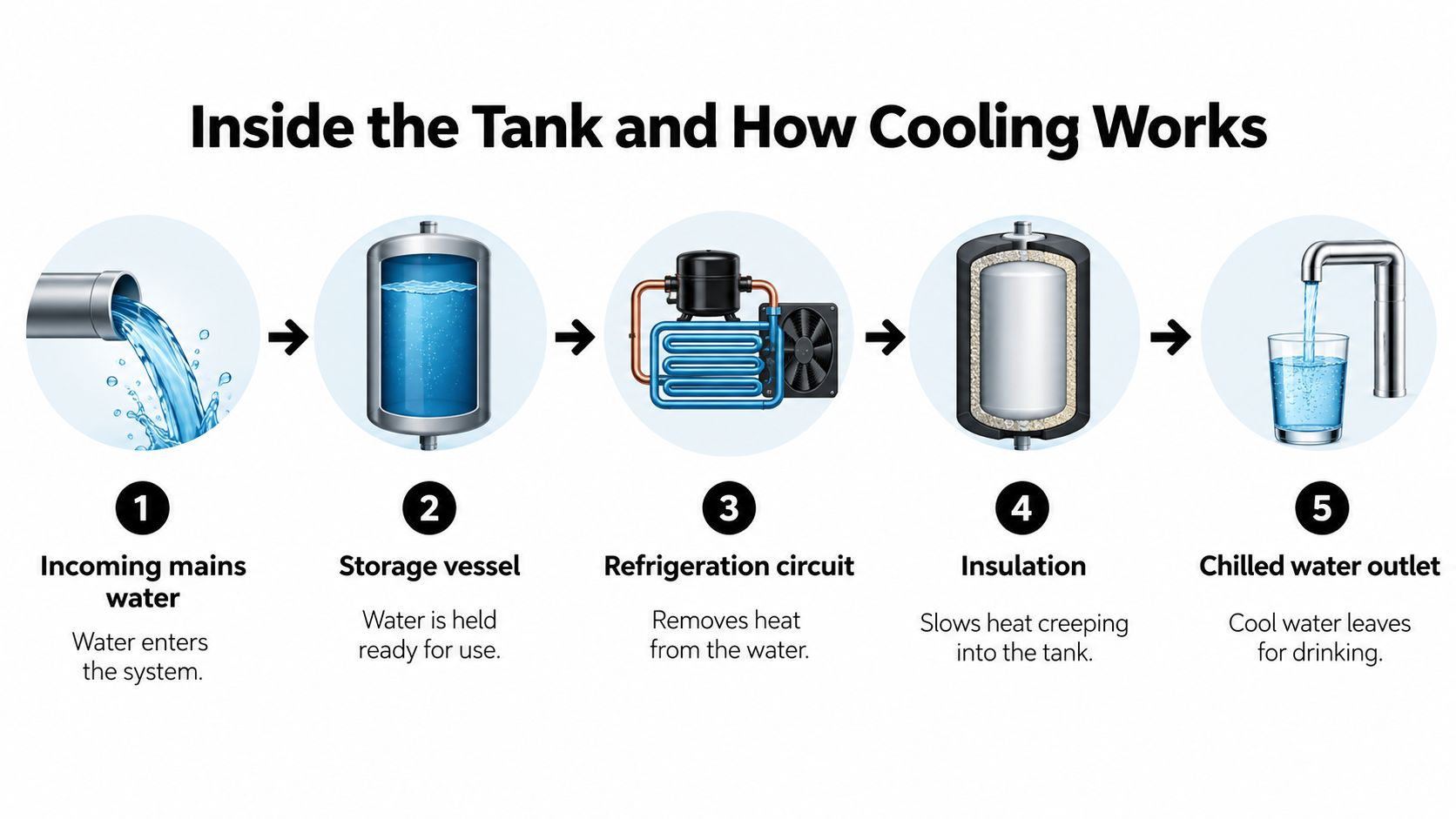
Cause and effect is ordinary once you can point at the parts. Warm inlet water, a sealed hot cupboard, or blocked airflow makes the compressor run longer because each litre carries more heat and the rejected heat has nowhere to go. Decent insulation and a flow that matches how people drink let the stored cold cover a short rush, then the machine recovers in the quiet gap afterwards.
This isn't a sizing exercise yet, and it isn't a fault guide. If you can stand at the unit and name the vessel, the level control, the compressor and where it rejects heat, the setpoint, the insulation, and the fittings back to the mains, you understand the machine well enough to choose and to brief a plumber.
Choosing Capacity Type and Design Temperatures
Nominal litres and nameplate watts are a weak buying test on their own. A compact under-sink chiller and a large institutional store can both be called "a chiller". They don't do the same day's work.
A home unit keeps filtered drinking water cold at one sink through long quiet gaps. A wall or under-bench office unit has to cover a morning cluster, then sit. A venue may need a larger store because the peak is sharper and running out means a queue, not a mild inconvenience. Volume only helps if the refrigeration can recover before the next peak, and if the vessel won't hold water that nobody draws. A tank too big for its draw is a hygiene problem wearing a capacity badge, because the same water sits longer between refreshes.
The temperatures that make capacity mean something
For a drinking-water tank, three numbers do the work. Usable stored volume is how much cold water you can draw before the outlet runs tepid. Recovery time is how long the compressor needs to pull the store back down after a rush. Inlet water temperature is what arrives from the mains, and Melbourne mains run warmer in summer, so the same unit works harder in January than in July to fill the same glasses.
Setpoint figures quoted for building-scale chilled-water plant get carried into catalogues as if they applied to a bubbler. They describe a different job. Those systems are engineered around entering and leaving water temperatures chosen for air-conditioning loads across whole floors, not for keeping a few litres fresh at a tap. A drinking tank lives or dies by how cold the stored water stays, how fast it comes back after a draw, and whether the contents turn over often enough to stay fresh.
That last point gets missed in most comparisons. Say one unit holds its store a couple of degrees colder than another. The colder unit still loses if it is oversized and the same litres sit in it for days, because stagnant cold water is still stagnant water.
Four checks before you compare models
| Check | What to record | Why it changes the choice |
|---|---|---|
| Peak draw | How many people, and for how long | Sets stored volume against a real rush, not a catalogue litre rating |
| Inlet conditions | Summer mains temperature and filtration | Warm inlet water adds workload the nameplate may not show |
| Recovery and turnover | Quiet gaps versus all-day draw | A unit that never rests wastes energy; one that never empties holds stale water |
| Heat and access | Cupboard temperature, airflow, filter reach | Standby use and service access decide whole-of-life cost |
To put the checks into practice, take your busiest half hour to the supplier and ask for the unit's recovery time at a stated inlet temperature. If they can only quote the nameplate, you have not found out whether it suits that rush.
The lowest whole-of-life cost is the unit that matches your duty cycle and turns its water over, not the one with the smallest compressor watts.
Homes, offices, and hospitality venues around Melbourne can line that brief up with chilled-water equipment and genuine fittings through a local supplier such as Ring Hot Water, including the under-sink and commercial water chillers people service after the first summer. Write the four checks down before you compare models.
How Homes Offices and Venues Use Chiller Tanks
A family of four, a sixty-desk office and a weekend café could each buy the same under-bench chiller and get three different results. The vessel is a potable store first and a cooling appliance second, so each setting changes what "working well" means.
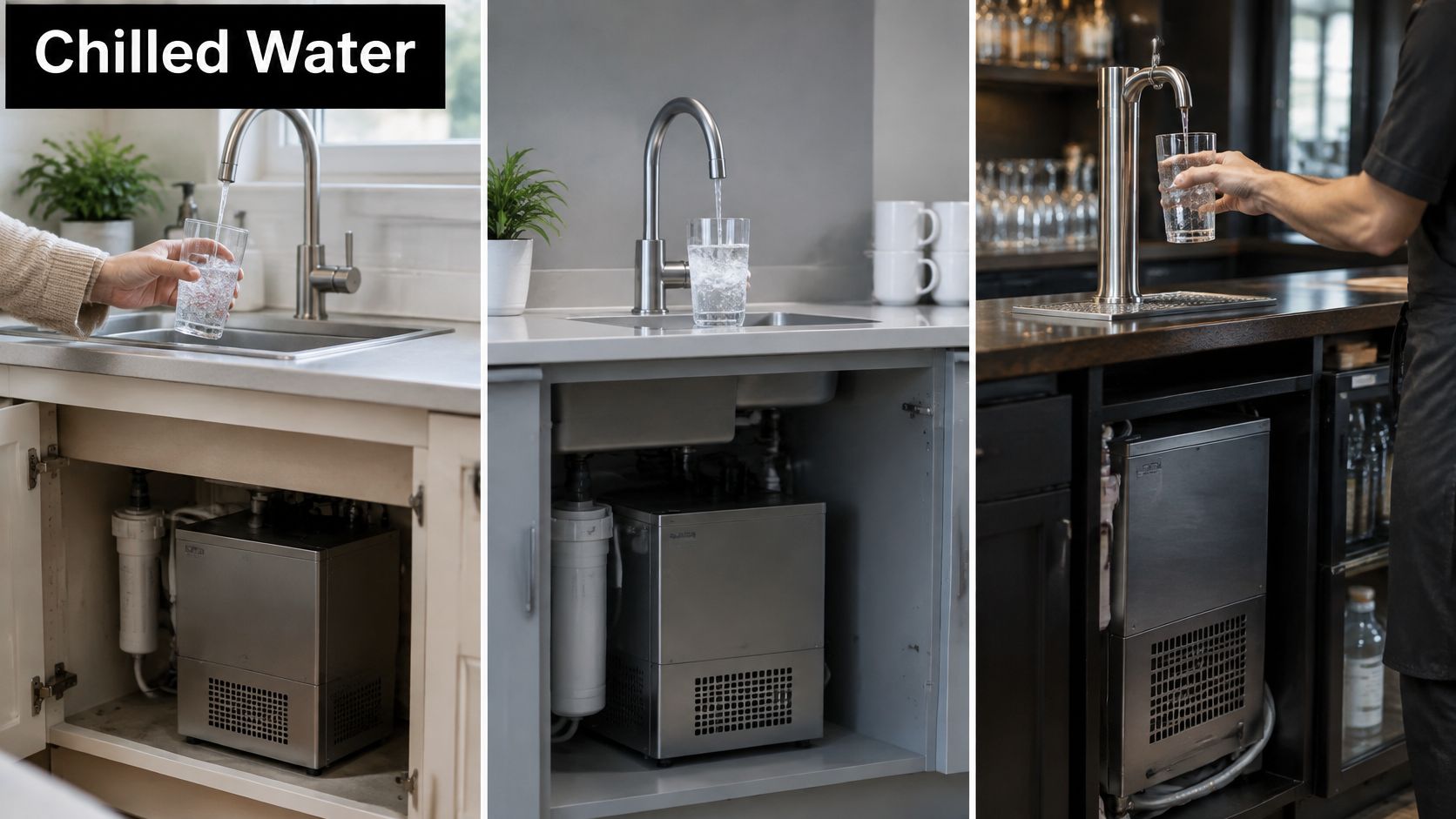
At home, success is chilled filtered water at the sink without a second cooler crowding the bench. Draw is lumpy: breakfast, after school, a hot evening. The tank should cover those bursts and then rest. If the household travels for a fortnight, that same store becomes still water in a warm cupboard, and the question shifts to stagnation, flushing and when the filters were last changed.
In an office, the facilities manager wants the morning cluster covered and a quiet machine afterwards. Recovery between draws matters more than sheer volume. A vessel so large the afternoon draw never refreshes it leaves water sitting longer than it should, while a unit that short-cycles all day wears itself out serving nobody.
In hospitality, cold drinking water has to sit beside hot urns and stay available through a full service. Parts need to be swappable without a long shutdown, because a dead dispenser on a Saturday means lost trade. Frequent use is a hygiene advantage here since the tank turns over constantly. The risk shifts to heat from nearby equipment and to filters nobody can reach during a rush.
Potable storage versus building cooling plant
Facilities teams already treat cooling, water and upkeep as one problem, and the scale of whole-building plant explains why. Australian Government HVAC guidance says heating, ventilation and air-conditioning can account for up to 50% of a commercial building's energy use. That plant moves heat out of rooms. A drinking-water chiller tank does a narrower job: it holds water people will consume, at a temperature that keeps it pleasant and hygienic, inside a vessel that has to be cleaned and drained.
Teams comparing how other markets run commercial cooling plant, including the contractors keeping Sebring commercial properties comfortable, deal with condensers, rooftop units and air handlers. None of that equipment touches the water in a glass. The lesson for a kitchen vessel runs the other way: match the tank to the people drinking from it, and treat stagnation as a real failure mode rather than an afterthought.
A short walkthrough of an under-bench drinking setup shows the vessel sitting inside ordinary kitchen cabinetry beside the sink:
Read your own day before you read a product ranking. Homeowners should weigh recovery and holiday stagnation. Office managers should weigh the morning peak, noise and turnover. Venue operators should weigh nearby heat, spare parts and whether the water inside refreshes every service.
Installing a Water Chiller Tank Without Guesswork
Once you know the day the tank has to survive, the site has to make that day legal and reliable. In Australia the vessel is part of the drinking-water service, not a plug-in accessory you can tuck behind a dishwasher and forget.
What the paperwork is really asking
Prefabricated cold-water storage, including tanks with float-control valves, is covered by WMTS-026:2016, which replaced ATS 5200.026:2004. Materials and coatings that touch drinking water need to comply with AS/NZS 4020. Tank design ties back to AS/NZS 3500.1, which Standards Australia applies to new water services and to alterations, additions, and repairs. Tanks over 500 L need a sludge valve, with the minimum size set under AS/NZS 3500.1, because a larger vessel collects more sediment and needs a planned drain. Most under-sink drinking chillers sit well under that threshold. The idea still matters: if you can't drain or flush the vessel, sediment and stale water have nowhere to go.
Melbourne installers keep meeting the same physical limits.
Heat the compressor rejects needs a path out. A sealed joinery box turns the cupboard into a warm room and the chiller into a machine that never rests.
Service clearance is not a luxury. Filters, the sludge point on larger tanks, and the fittings a plumber will undo in two years all need a hand and a light.
Pipework should be protected from sun and from plant-room heat. A chilled vessel feeding a hot, uninsulated branch gives the cold away before the glass.
Dead legs are unused branches where water sits. Don't add one "just in case" behind a future servery.
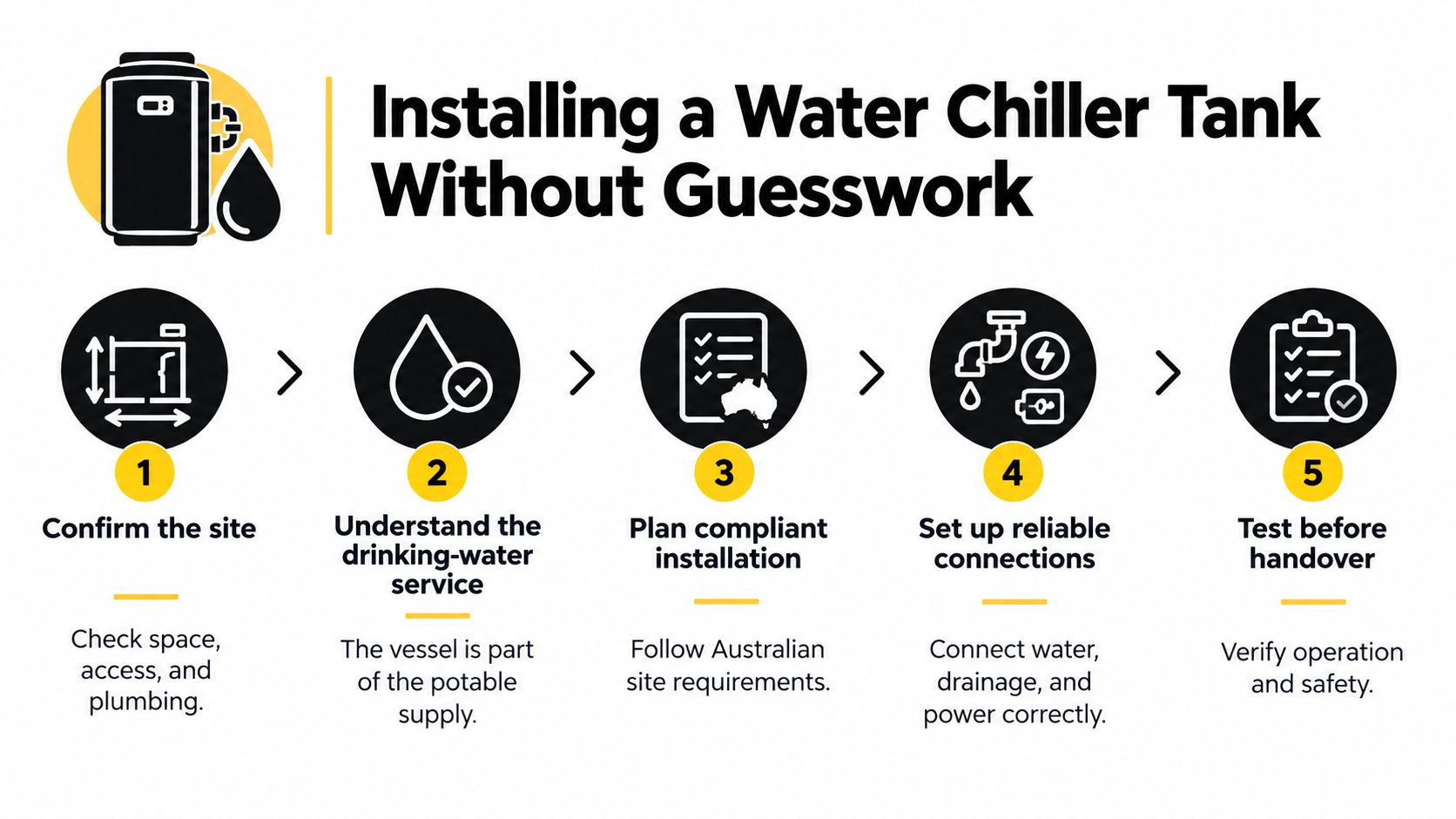
Before anyone cuts pipe, a short list is enough to brief the job: potable-contact materials, a real drain or flush path, ventilation for rejected heat, and a connection a licensed plumber can sign off. If you want the site sequence written out for a Melbourne kitchen or servery, the water chiller installation notes follow that order from confirming the space through to a test before handover. Guessing the cupboard now is what creates the noisy, lukewarm unit later.
Keeping Stored Water Cold Clean and Efficient
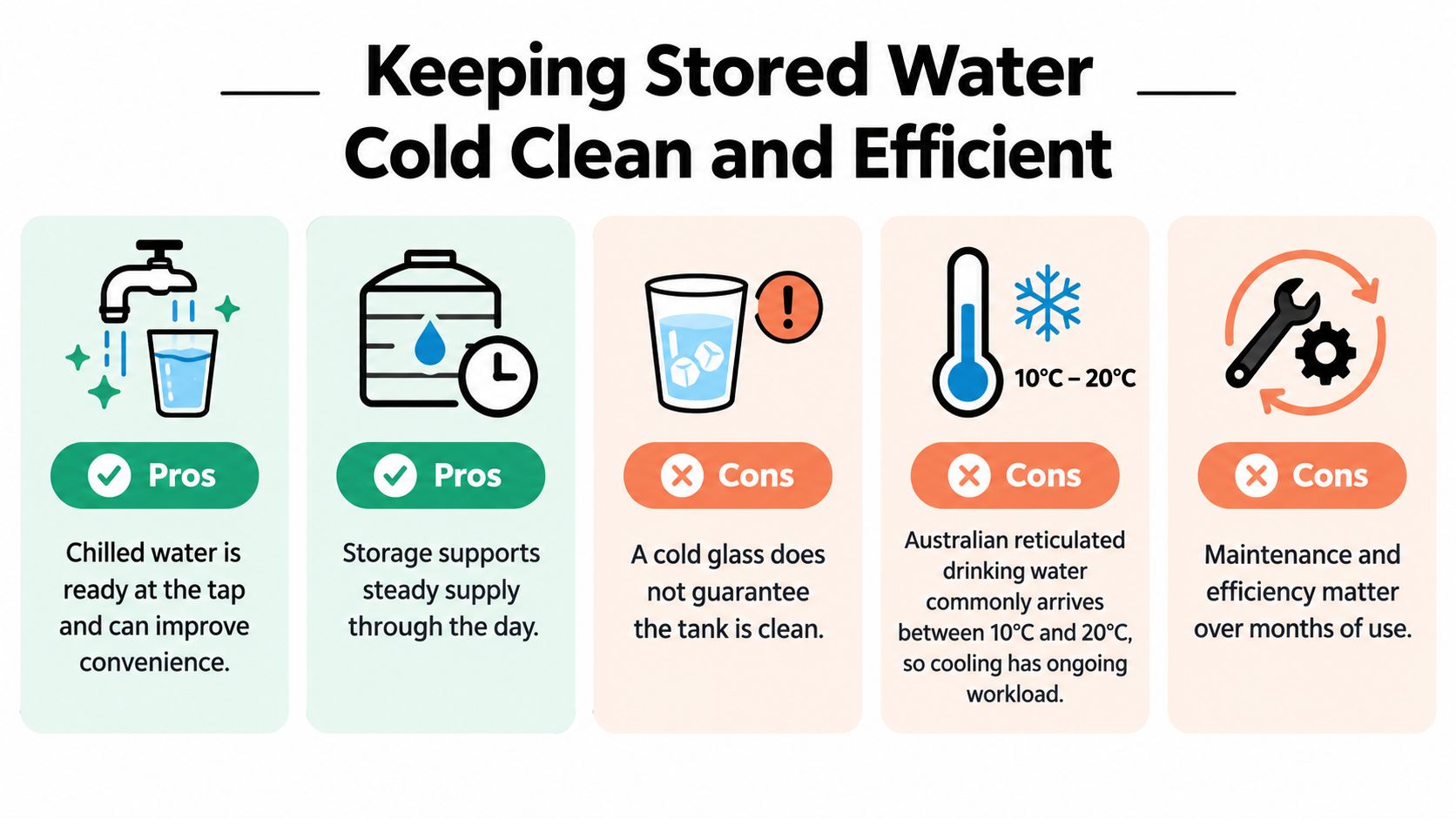
A cold glass doesn't prove the tank is fine. It only proves the last litre at the outlet was cold enough to feel pleasant. Water upstream of that mouthful can still be warm, still, or sitting on a dirty filter.
The NHMRC drinking-water guidance on temperature reports that Australian reticulated drinking water commonly arrives between 10°C and 30°C, that temperatures above 20°C may increase complaints, and that stagnant water between 20°C and 45°C can support Legionella colonisation. No specific drinking-water guideline value has been set for Legionella, so there isn't a single lab number that lets you ignore design and upkeep.
Where the cold story breaks
A warm plant room, bare pipework, or compressor heat beside the circuit can lift stored-water temperature even while the dispenser still feels chilled. Infrequent use, a long unused branch, or a filter left for months does the same job more slowly. enHealth's Legionella control guidance warns that compressor heat may create favourable growth temperatures in water supplying chilled dispensers, and notes that Legionella can survive freezing. Colder isn't a free pass.
In health and aged-care work, that guidance expects new tanks and plumbing to be chlorinated before commissioning, and it doesn't recommend activated-carbon filtration for ice machines and water coolers in those settings. Homes and ordinary offices aren't those buildings, but the mechanism is the same: temperature, time sitting still, and what the water touches.
A useful rhythm looks different from the install checklist:
- Hot-weather readings: Check tank and outlet temperature on a hot afternoon, not only on a mild morning.
- Insulation: Look for crushed, wet, or missing lagging on the vessel and the first run of pipe.
- Stagnation: Flush rarely used branches, or remove them. A tank that only works on Fridays needs a plan for the other days.
- Filters: Replace them on the maker's interval. Taste is a late signal.
- Sanitising: Do it when the site, a health setting, or a long shutdown requires it, not as a random extra.
If the compressor runs for long stretches, the outlet is lukewarm by the third glass, sediment shows at a drain, or the taste goes odd after a quiet week, believe the symptom. A chiller maintenance schedule is the practical way to keep those checks on a calendar instead of waiting for a complaint. Stored water is only as reliable as the last time someone measured it and moved it.
What to Do Next for a Reliable Chilled Supply
You don't need another explanation of refrigeration. You need a one-page brief.
Write down four facts: the peak draw you get, where the tank will sit and how hot that spot becomes, what incoming water is like in a Melbourne summer, and who will change filters and read temperatures after handover. That note is the quote. It stops a supplier sizing from a catalogue line, and it stops you buying storage you won't turn over.
Homeowners, office managers, hospitality venues, and plumbers can take that brief to Ring Hot Water at ringhotwater.com.au for chilled-water units, filtration, and genuine spare parts, with installation and repair across metropolitan Melbourne and store delivery Australia-wide. If a tank is already in and the outlet temperature, noise, or taste has drifted, use the same four facts as the service request. Cold drinking water stays reliable when the vessel, the pipework, and the maintenance were chosen together, not when the glass happened to be cold on day one.
Ring Hot Water supplies chilled-water units, drinking-water filtration, and genuine spare parts for homes, offices, and hospitality venues, and can match a water chiller tank to your peak draw and service plan. Local installation and repair cover metropolitan Melbourne, and the store delivers Australia-wide. Visit Ring Hot Water with your four-point brief, or ask for an existing tank to be checked if temperature, noise, or taste has drifted.