You're filling the kettle for the third time today, the filter jug is sitting half empty on the bench again, and you're wondering if there's a better way to get drinking water that tastes good. That moment at the tap is where most Melbourne households start shopping. The honest answer isn't always to buy something.
Standing at the Kitchen Tap and Deciding
You've probably got three options running through your head. Keep refilling the benchtop jug and swapping its small cartridge constantly, keep buying bottled water and storing it somewhere, or fit a proper under-sink system and use cupboard space instead of bench space. Each one works. Each one annoys you in a different way.
A jug costs little upfront and needs no plumbing. It also runs dry when you're cooking, fills slowly, and only helps if someone remembers to refill it. Bottled water solves taste instantly, but you're paying for packaging, carrying it home, and finding room for empties. An under-sink filter gives you water on demand at the tap, yet it commits you to installation and cartridge changes.
What the daily routine really looks like
Think about how you use water. Tea, coffee, filling drink bottles, rinsing fruit, topping up a pot. If that's constant through the day, on-demand flow matters more than the purchase price. If you only drink a glass or two at home, a jug may be enough and an under-sink unit is hard to justify.
- Bench space matters: A jug or bottle stash lives where you prep food, while an under-sink housing hides below.
- Cupboard space matters too: Cleaning products, bins and pipes already compete under most sinks.
- Habits decide value: A system you forget to maintain won't outperform the tap you already have.
If you're also weighing up tapware or a kitchen tidy up at the same time, getting practical bath kitchen plumbing help early can stop you buying a filter that doesn't suit your mixer, bench thickness or cupboard layout.
My rule is simple. Buy filtration to solve a named problem, not because the word filtered sounds safer.
That's the lens for everything that follows. Sink filtered water can be excellent for taste, useful for specific plumbing concerns, and appropriate for a verified contaminant issue. For many Melbourne homes on treated mains, it's a preference, not a health necessity. Knowing which camp you're in saves money and stops you oversizing the system.
What Sink Filtered Water Actually Means
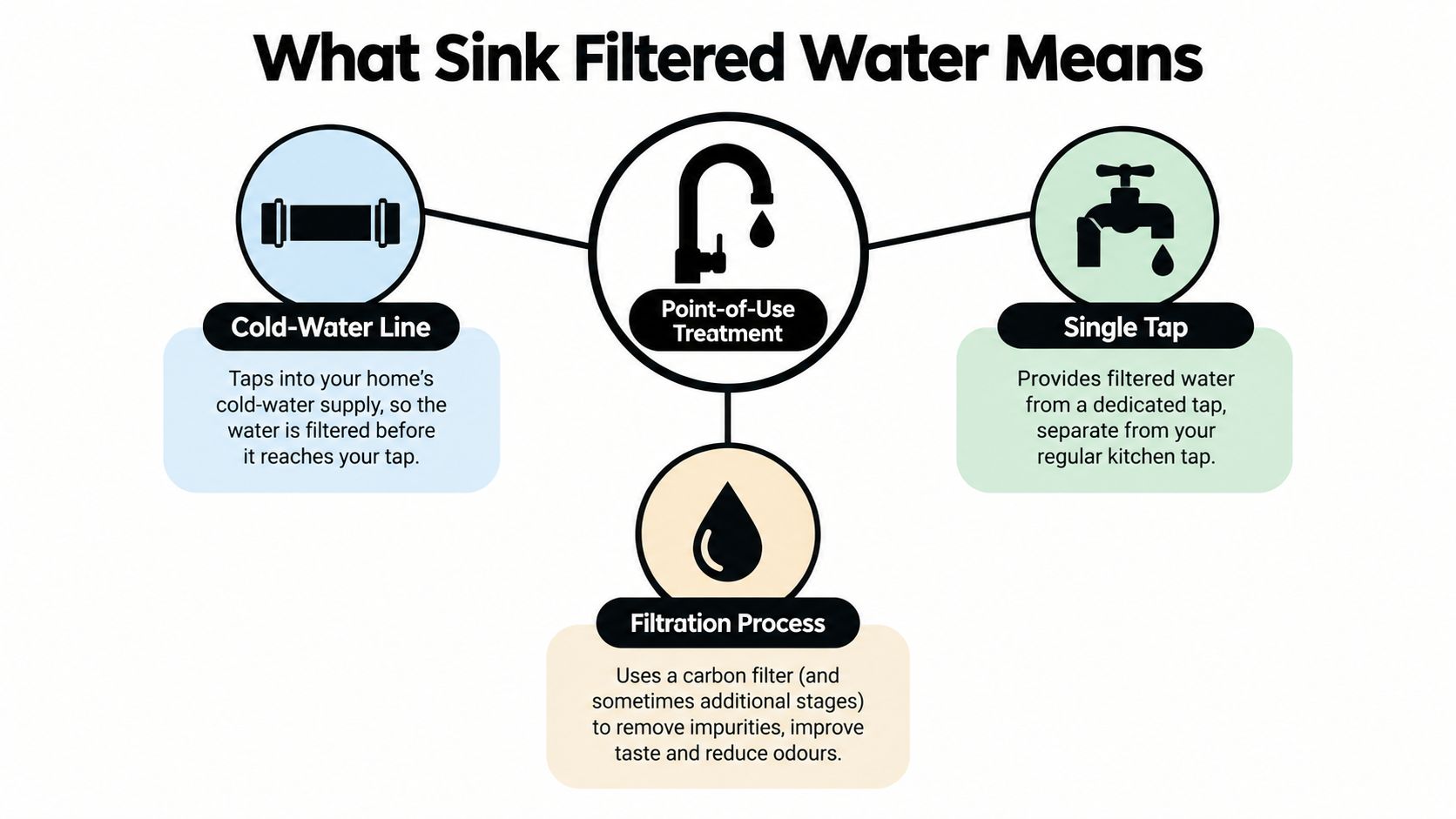
Two taps can sit on the same bench and deliver different water. Sink filtered water is point-of-use treatment: cold mains water diverts under the bench, runs through one or more cartridges, and exits at a single outlet. Sometimes that outlet is a slim dedicated filter tap beside your mixer. Sometimes it's a 3-in-1 mixer carrying hot, cold and filtered lines through separate internal paths.
One outlet, one job. Your shower, laundry and garden tap stay untreated. So does the hot line, because drinking filters are fitted to the cold-water line. You're upgrading a single drinking point, and that framing should drive every decision you make about cartridges and cost.
Terms worth understanding before you buy
Product pages quote specs with no context behind them. What the three that matter tell you.
| Term | What it actually tells you |
|---|---|
| Micron rating | The particle size a cartridge can screen out. Lower means finer physical filtration, and it says nothing on its own about dissolved chemicals. |
| Flow rate | How fast filtered water reaches the glass. Too slow and you'll stop using it for cooking. |
| Rated capacity | The volume or time a cartridge is validated for. Past that point, performance claims no longer apply. |
Pressure range belongs on that list too. A cartridge needs enough pressure to perform, and your housing and fittings need protection where incoming pressure runs high. Ask for those numbers in writing. A brand name and a photo of a smiling family tell you nothing.
None of this is exotic in Australia. The Australian Bureau of Statistics household water survey reported 28.6% of Australian households used a water filter in 2007, up from 18.2% in 1998, while 93.4% identified mains or town water as a source. Filtration is an extra step applied to supplied water, and treating it that way keeps your expectations honest.
When Melbourne Mains Water Already Does the Job
Most filter marketing starts from fear. I start from the opposite question. Why would you add treatment to water that's already treated?
Victorian Health drinking water guidance states that treated reticulated tap water generally does not need additional filtration. It also advises that filters should be replaced regularly and certified to an appropriate standard, and recommends using cold water for drinking and flushing stagnant water after extended non-use. That's a measured position, and Melbourne homeowners should take it seriously.
Taste is a valid reason. Do not dress it up as danger
Chlorine taste or smell puts plenty of people off drinking from the tap. If a carbon filter means you and your kids drink more water and buy fewer bottles, that's a worthwhile outcome. Just call it what it is, a sensory improvement. Better taste alone doesn't prove your unfiltered water was unsafe.
The same applies after plumbing work or in a newly renovated kitchen. Temporary taste changes might settle. Don't rush into a multi-stage system before you've flushed the line properly and confirmed the issue persists.
Where filtration earns its place
There are three practical triggers I respect.
- Persistent taste or odour: You've flushed, you're using the cold tap, and chlorine character still puts you off.
- Older plumbing concerns: Metals such as lead and copper can leach from some plumbing products, especially after stagnation.
- A specific verified concern: Local water quality information or testing points to a contaminant you need to target.
Don't use a filter to paper over defective plumbing. Fix the plumbing first, then decide if filtration still adds value.
Flushing after holidays or overnight non-use costs nothing and should be habit in older homes. If you're still concerned about metals, choose a cartridge with a documented claim for that metal. A generic taste cartridge isn't automatically a lead solution, no matter what the box art implies.
Comparing the Main Filter Technologies
Forget stage counts for a moment. Four technologies do most of the work in under-sink systems, and they do different jobs. Stacking more housings under your sink doesn't help if the media inside doesn't match your problem.
The Australian Drinking Water Guidelines framework is the national evidence based reference for safe drinking water. It notes that activated carbon primarily adsorbs many organic compounds and chlorine, while particulate cartridges mainly reduce suspended solids, and neither should be assumed to provide reliable pathogen or PFAS removal without a specific validated claim. Read that twice before trusting a sales pitch.
Under-sink filter technologies at a glance
| Technology | Targets | Limitations | Best fit |
|---|---|---|---|
| Activated carbon | Chlorine, taste, odour, many organics | Exhausts over time, PFAS performance varies by product | Most taste focused homes |
| Sediment cartridge | Sand, rust and suspended particles | Doesn't address dissolved chemicals | Protecting downstream stages |
| Reverse osmosis | Broad range of dissolved contaminants | Slower flow, wastewater, more space and upkeep | Verified dissolved contaminant concerns |
| Ion exchange | Specific charged contaminants, including some PFAS | Media is selective and capacity limited | Targeted treatment with documented claims |
Activated carbon is the workhorse. Granular carbon and carbon block both adsorb chlorine and improve flavour, with block formats also providing finer physical screening. For most Melbourne taste complaints, a decent carbon system is enough. Buying reverse osmosis for chlorine taste is like buying a truck to carry groceries.
Sediment filtration is a supporting act. It catches particles and protects finer stages from clogging early. On its own it won't fix chemical taste, and clear water after a sediment cartridge doesn't mean dissolved contaminants are gone.
When broader treatment makes sense
Reverse osmosis pushes water through a membrane and rejects a broad range of dissolved material. It's powerful, but you'll trade cupboard space, flow speed and water efficiency for that breadth. I recommend it when there's a defined reason, not as a default upgrade.
Ion exchange swaps target ions for others held on resin media. It's selective by design, which is a strength for defined contaminants and a weakness if you expect it to handle everything. Multi-stage systems often combine sediment, carbon and ion exchange so each stage handles the load it's suited to.
If you're shortlisting systems, use a structured water filter system comparison for Melbourne homes and force every option to answer the same questions. What's the contaminant claim, who validated it, what's the rated capacity, and what happens to flow as the cartridge loads up? A seller who can't answer those clearly hasn't earned your money.
The PFAS Question and the 2025 Guideline Update
Panic sells cartridges. Since the guideline numbers tightened, homeowners have been ringing me ready to spend serious money on a contaminant class they cannot even name. The right sequence is dull but it works: your supply result first, the guideline values second, product proof third.
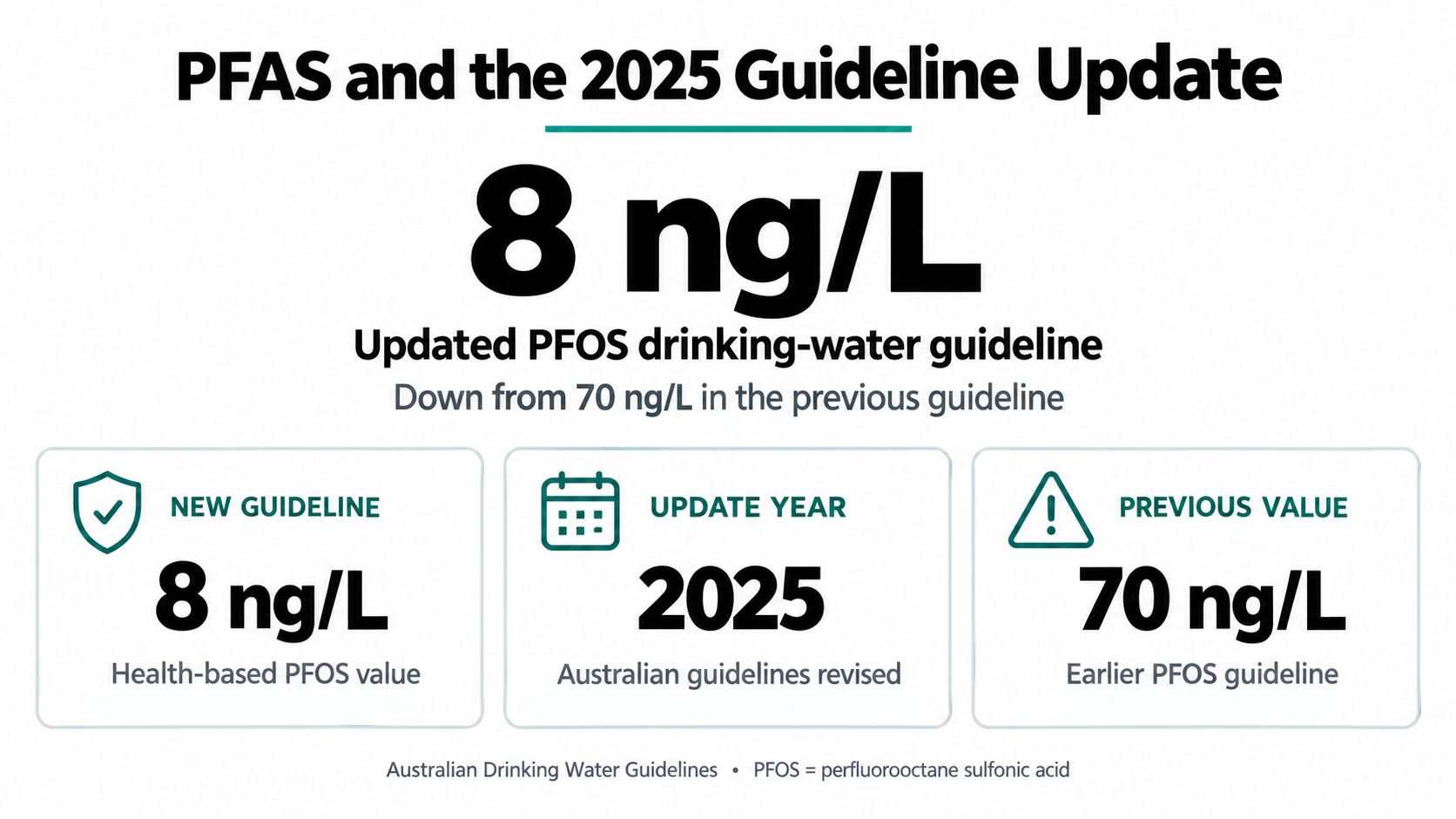
The June 2025 Australian Drinking Water Guidelines PFAS update set health based values for four compounds, and the spread between them is enormous:
| Compound | Health based value |
|---|---|
| PFOS | 8 ng/L |
| PFHxS | 30 ng/L |
| PFOA | 200 ng/L |
| PFBS | 1,000 ng/L |
PFOS sits in single digits while PFBS runs to four figures. That spread is why "removes PFAS" printed on a box tells you almost nothing.
The same NHMRC advice states that households on reticulated supplies sitting below those values do not need additional home treatment. Read both halves together. Quoting only the tighter numbers manufactures alarm that was never in the document.
So before you spend a dollar, pull up your local water quality information. If your reticulated supply sits below the guideline values, a PFAS cartridge is optional extra assurance and you should weigh it like any other optional spend. A private supply, a known local contamination issue, or a lab result that concerns you is a different conversation, and targeted treatment earns its cost there.
When you do shop, NHMRC identifies granular activated carbon, ion exchange and reverse osmosis as commonly used PFAS treatment approaches. Plenty of taste cartridges contain carbon and have never been validated against a single PFAS compound. Three questions separate the genuine products: which compounds were tested, at what challenge level, and to what endpoint. Ask what the claim looks like at end of rated life too, because a cartridge near exhaustion cannot be assumed to keep delivering its original performance.
Buying rule for PFAS: No written, compound specific reduction claim means no PFAS credit, regardless of branding.
PFAS at the levels households discuss has no taste and no smell, so your tongue cannot audit the cartridge. Documentation and replacement discipline do the auditing. A supplier leaning on fear without a lab basis has told you everything you need to know.
Maintenance Rules Most Owners Skip
A filter can be dead while the tap still runs clear. That is the trap with under-sink cartridges: flow and sparkle tell you almost nothing, and Melbourne water that already tastes decent can mask a spent stage for months.
Australian water quality guidance on turbidity and filtration performance treats turbidity as a surrogate for pathogen removal and makes the same point from the other side: an exhausted carbon stage may still pass water normally while adsorption has fallen away. Replace when capacity, time or pressure-drop limits are reached, not when flavour finally offends you.
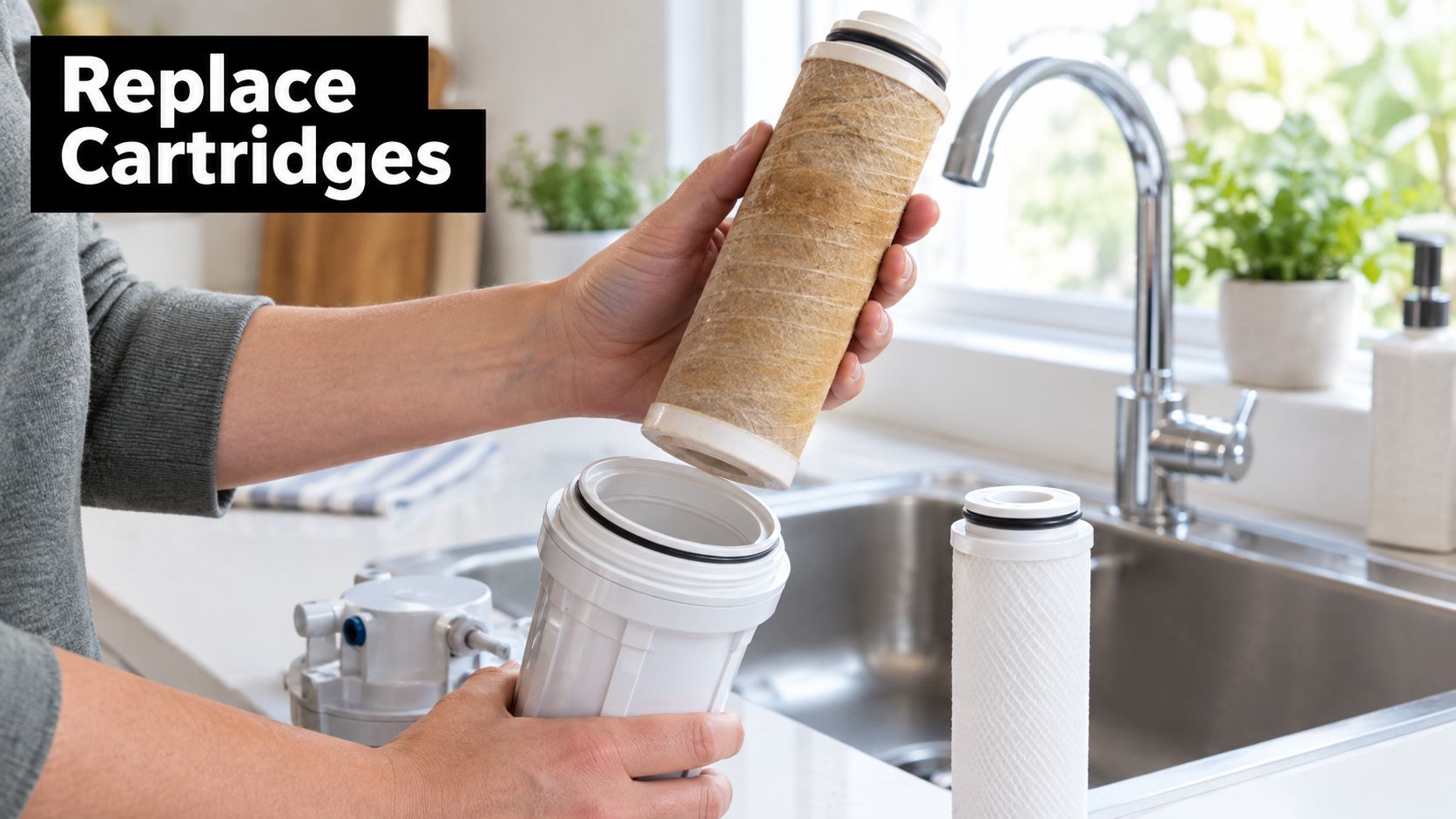
The service interval has three clocks. Set them before the cupboard door closes.
| Clock | What it tracks | My rule |
|---|---|---|
| Rated volume | Litres through the media | Busy kitchens hit this first |
| Time | Ageing, sitting, low use | Holiday homes still expire |
| Pressure and flow | Sediment loading | A slowing stream is a clog, not a personality quirk |
Write the install date on the housing and calendar the change before the installer leaves. Memory is a lousy service interval.
Hardware that hides the cartridge behind fixed shelves gets neglected. Ask for accessible fittings and enough room to change the cartridge without a plumbing degree, then glance under the sink now and then for damp joins.
For PFAS or microbiological claims, in-date media is part of the claim. If you do not want to track it, book scheduled water filter servicing and cartridge replacement. If your only problem was ordinary Melbourne taste, remember the cheaper option too: no cartridge, nothing to maintain.
Setting Up Sink Filtered Water the Right Way
A competent install looks boring. No leaks, sensible clearances, labelled dates and a tap that flows properly from day one. That result comes from sequence, not speed.
Use this checklist image as a plain language summary of the commissioning steps your installer should work through.
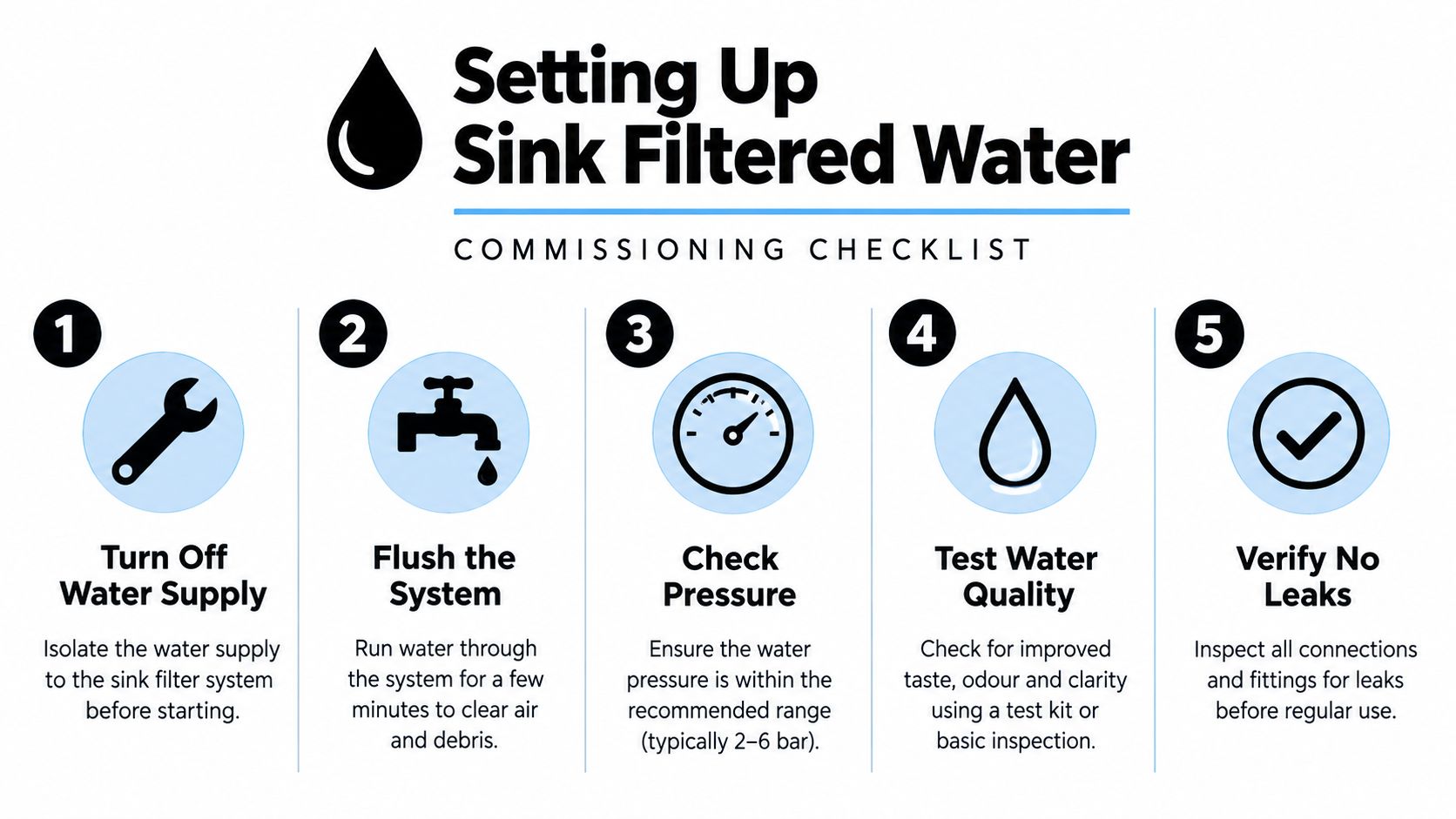
A practical commissioning sequence
- Isolate the cold feed: Confirm the shut-off works before disconnecting anything, and drain residual pressure at the tap.
- Mount for future swaps: Position housings upright with clearance below for cartridge removal and a bucket.
- Fit protection and tapware: Add a pressure limiting valve where required, then install the dedicated tap or 3-in-1 mixer neatly.
- Flush before judging taste: Run the manufacturer's first flush to clear carbon fines and air from the line.
- Leak check twice: Inspect every join under pressure, then check again after the system has sat and been used.
Don't skip the first glass test. It should look clear and taste neutral after flushing. Fine black specks early on usually mean carbon fines need more flushing, while persistent cloudiness, spurting or very slow flow needs investigation before handover.
The short video below is useful for visualising the under-sink connections before work starts in your kitchen.
Before anyone packs up, confirm the isolation valve works, flow at the filtered outlet is usable for filling a pot, and the replacement schedule is documented. Homeowners in Sunshine or Footscray with tight cupboards should raise access early, because cartridge clearance decides whether servicing is a simple twist or a plumbing excavation. A detailed under-sink water filter installation guide can help you sanity check the brief you give your plumber.
Choosing With Confidence and Knowing When to Call
Use one decision rule. Name your problem in a single sentence, then buy only the technology that addresses that sentence.
If your sentence is about chlorine taste, start with quality activated carbon. If it's about plumbing related metals after stagnation, flush first, fix suspect fittings, and choose a cartridge with a documented metals claim. If it's about a verified PFAS or dissolved contaminant concern, shortlist documented granular carbon, ion exchange or reverse osmosis options and maintain them strictly to spec.
Call a specialist when the picture stops being simple
- Taste persists with a fresh cartridge: Something upstream, in the plumbing or in product selection isn't right.
- You have test results or a known local concern: Product choice needs to match compounds and concentrations.
- You're pairing filtration with boiling or chilled water: Flow, pressure and cartridge sizing need to work together.
Ring Hot Water supplies and installs under-sink filtration alongside boiling and chilled systems across Melbourne, which makes it one option when those systems need to be sized as a package. Whoever you use, ask the same direct questions and expect written answers. Guidelines and local reporting will keep evolving, so treat today's choice as a maintained decision you can revisit, not a set and forget badge of safety. That's how sink filtered water stays useful instead of becoming expensive cupboard clutter.
If you're ready to match a filter to your actual taste, plumbing or PFAS concern, talk to the Melbourne team at Ring Hot Water about under-sink filtration, boiling and chilled tap options, and scheduled cartridge servicing. Bring your water quality questions and cupboard measurements, and you'll get a recommendation sized for your kitchen rather than a generic sales package.