On a Tuesday morning in Yarraville, the kettle is boiling, the reusable bottles are lined up beside the sink, and a stack of empty water containers is waiting near the back door. Across town in a Brunswick coworking space, someone is checking whether the last delivered bottle will survive the morning rush. Both situations point to the same question: would a filtered water cooler make drinking water simpler without creating a new maintenance problem?
For most Melbourne properties connected to a reticulated mains supply, the answer isn't automatically “buy the strongest filter available”. The practical choice usually turns on taste, chilled-water access, convenience, installation, hygiene and serviceability. This guide separates those issues, compares bottleless and bottled systems, explains what common filtration technologies do, and connects the latest Australian PFAS guidance to sensible buying decisions.
Why Melbourne Homes and Offices Are Switching to Filtered Water Coolers
A plumbed-in cooler appeals because it removes several small tasks from the day. There's no bottle to lift, no delivery to schedule and no need to keep full containers in a garage, storeroom or office utility area. The unit draws from the cold-water line, treats the water at the point of use and dispenses it chilled, ambient or hot, depending on the design.
That convenience matters in a busy family kitchen, but it becomes more obvious in a shared workplace. A bottleless system can give staff and visitors a consistent chilled-water point without asking one person to monitor stock or replace heavy containers. In hospitality, the calculation also includes recovery time, access for cleaning and whether the machine can cope with concentrated demand.
Melbourne water can also taste different from one building to another because the final drinking experience depends on treatment, plumbing and the condition of internal fittings. Hardness isn't the same as contamination, and a water-quality complaint should be identified before a supplier specifies a cartridge. This guide to Melbourne water hardness is useful context when scale or mineral taste is influencing the decision.
Practical rule: Buy the dispensing experience you need first, then choose filtration that addresses a real water-quality or taste problem.
The history supports treating this as an established category rather than a novelty. The Australian Bureau of Statistics reported that 26% of Australian households used a water filter for drinking water in 2004, compared with 21% in 2001 and about 3% in 1994. Satisfaction with mains drinking water also rose from 64% in 1994 to 70% in 2004, which suggests filtration adoption wasn't driven only by fear about tap-water safety. Taste, convenience and control over temperature have long mattered too. ABS household water-filter data
What a Filtered Water Cooler Actually Is
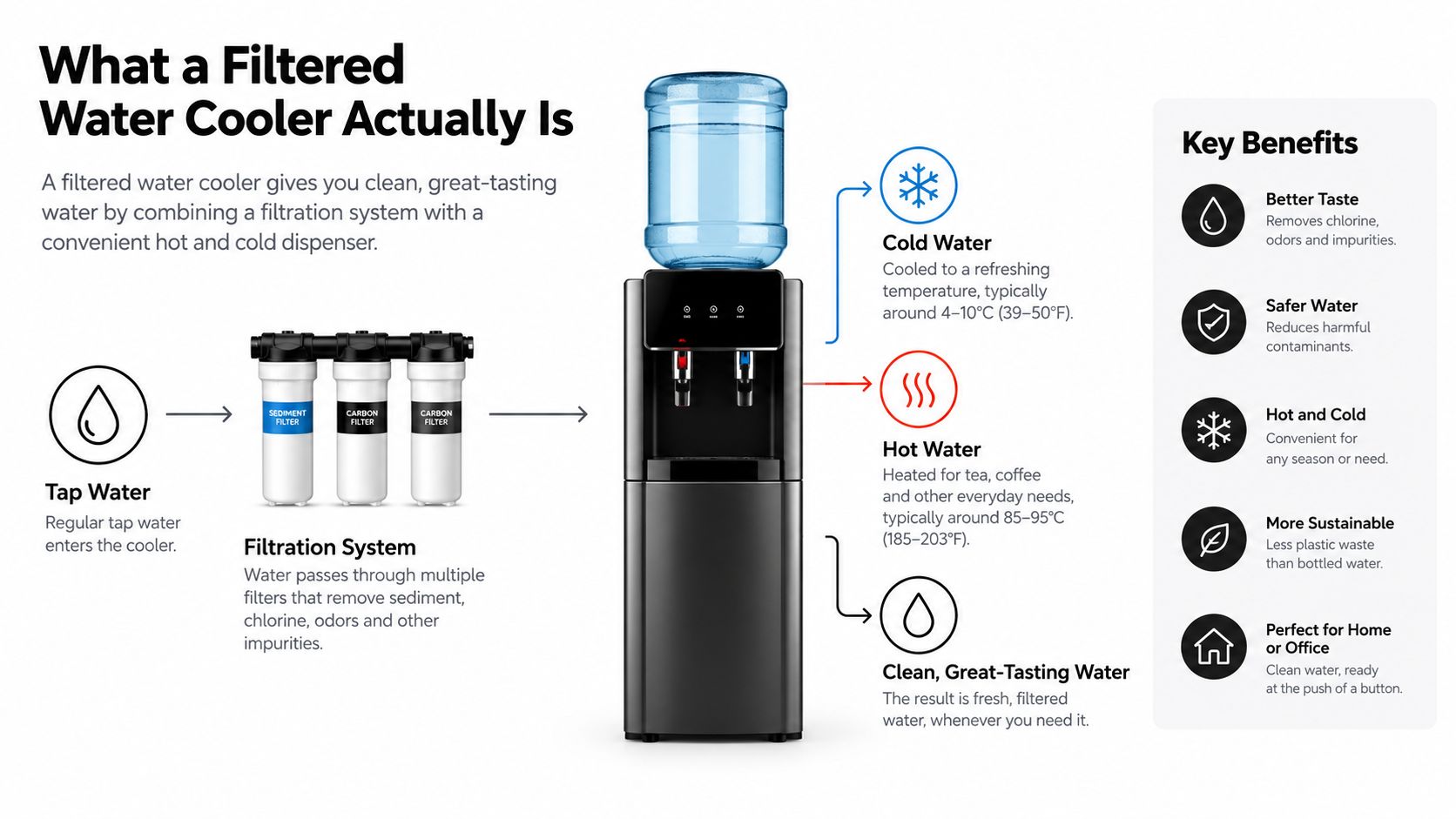
A filtered water cooler is a dispensing appliance connected to a building's potable cold-water supply. Water passes through one or more cartridges before reaching a chilled reservoir, refrigeration module, hot-water tank or boiling system. The filter and the temperature system perform different jobs, so a cooler can provide cold water without necessarily removing dissolved contaminants.
A typical installation has four functional parts:
- Water connection: A cold-water branch feeds the unit through an isolation valve.
- Filter housing: A replaceable cartridge reduces selected particles, tastes, odours or contaminants.
- Temperature system: A refrigeration module chills water, while a separate hot-water or boiling module heats it.
- Dispensing point: A tap, button or sensor delivers water into a glass or reusable bottle.
How it differs from other drinking-water equipment
A bottled water cooler relies on delivered containers, commonly 15-litre or 19-litre bottles, which feed an internal reservoir. The bottle may contain treated water, but the cooler itself doesn't necessarily filter the water as it dispenses it.
A counter-top filter jug is simpler and cheaper to position, but someone must fill it manually and wait for the water to pass through the cartridge. It won't provide the same continuous supply or integrated chilled output. A boiling tap focuses on hot water, usually under the sink, and may need a separate chilled-water solution if the household wants both temperatures.
Australia already had a substantial cooler market before mains-connected filtered dispensers became common. An industry estimate put the number of operating water coolers at approximately 150,000 in 2001, while home and office delivery businesses sold an estimated 117 million litres annually. Retail packaged water contributed about 75 million litres, and the on-trade sector added roughly 50 million litres, for an estimated 242 million litres of bottled water per year. Australian Parliament submission on bottled water
That established demand created the path for bottleless systems. The modern unit keeps the familiar chilled-water function, but replaces bottle logistics with a mains connection, filtration and planned servicing.
Bottleless Versus Bottled Water Coolers
The choice is less about which machine looks more modern and more about who will manage the water supply. A bottleless cooler needs a suitable cold-water connection, power and professional installation. A bottled unit can work almost anywhere, provided someone can receive, store and replace the containers.
| Criterion | Bottleless, plumbed-in | Bottled, 19L |
|---|---|---|
| Water source | Cold-water mains connection | Delivered container |
| Supply | On-demand while the building supply and appliance operate | Limited to the bottle in place |
| Filtration | Cartridge selected for the site and stated claim | Depends on the bottled-water supplier |
| Handling | No full bottles to lift or empty bottles to store | Regular lifting, storage and replacement |
| Hygiene | Closed water path still needs cleaning and sanitisation | Bottle changes and reservoirs need disciplined cleaning |
| Installation | Requires plumbing access, isolation and compliant components | Minimal plumbing, but needs floor or bench space |
| Waste and logistics | Reduces dependence on bottle deliveries | Requires delivery, collection and container handling |
| Best fit | Steady demand and a permanent location | Temporary sites, low use or locations without plumbing |
Where bottleless earns its place
Bottleless is usually the stronger operational choice for a busy office, coworking venue or hospitality site with a nearby cold-water line. It removes stockouts and storage, while filtration can improve chlorine taste, odour or sediment according to the cartridge specification. It also avoids treating bottle delivery as an invisible administration task.
The trade-off is that installation becomes part of the project. The unit can't be moved to another room easily, and the filter must be changed before pressure loss, taste changes or poor flow undermine the service. A mains-connected cooler also needs a flushing and cleaning procedure during shutdowns.
Where bottled still makes sense
Bottled equipment remains useful when the location is temporary, plumbing access is unavailable or water demand is modest. It can also suit a short-term event where permanent installation would be disproportionate. Its apparent simplicity can hide recurring work, however. Someone still has to check supply, move containers safely, clean contact points and arrange collection.
The decision rule is straightforward: choose bottled where installation is impractical or use is occasional; choose bottleless where demand is steady and a compliant cold-water connection is available. Don't select a bottleless system merely to claim “filtered” water, and don't choose bottled just because the purchase process looks easier.
Common Filtration Technologies and What They Actually Do
Filter marketing often compresses several very different functions into one word. A cartridge that improves chlorine taste isn't automatically suitable for lead, PFAS, microbes or dissolved salts. The supplier should identify the water issue, state the cartridge model and provide evidence for the specific contaminant claim.
Sediment and activated carbon
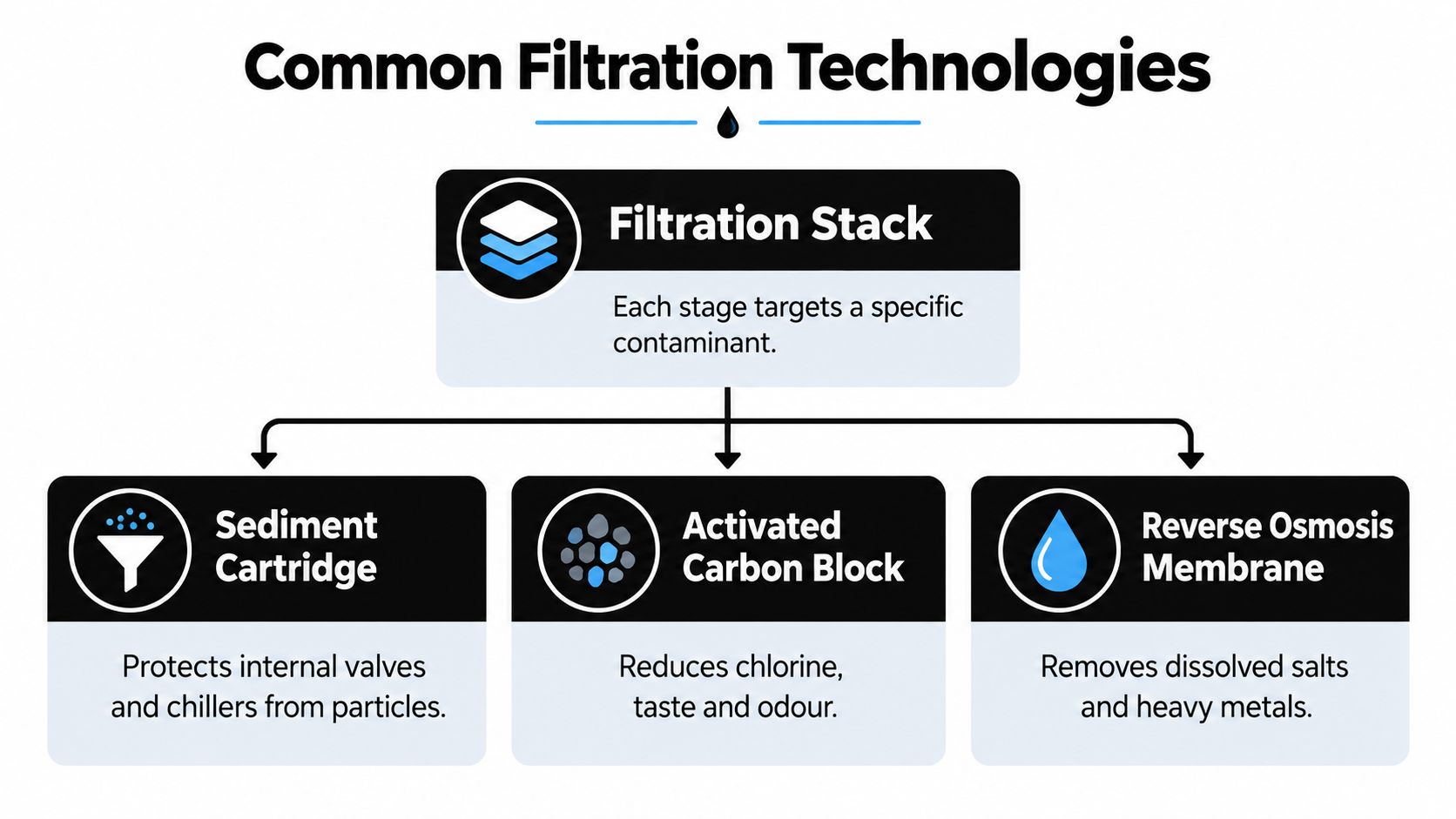
A sediment cartridge catches particles such as grit and rust fragments. It protects valves, chillers and outlet components from debris, so it can be valuable even when the incoming water is already compliant and tastes acceptable.
Activated carbon is mainly a taste-and-odour tool. It can reduce chlorine and related flavour complaints, making chilled water more appealing. It shouldn't be described as a universal contaminant-removal stage. The Australian Drinking Water Guidelines remain the national evidence-based reference framework, while the filter claim must come from the particular cartridge rather than from the word “carbon” alone. Australian Drinking Water Guidelines
Reverse osmosis and UV
Reverse osmosis can reduce a wider range of dissolved substances, including salts and some metals, when the membrane and complete system are correctly specified. It normally brings trade-offs, including slower production, lower flow and a wastewater stream. For an ordinary Melbourne mains installation, those costs may not be justified unless testing or supplier data identifies a reason to use it.
UV treatment targets microbial control rather than chlorine taste or hardness. It can have a role where source-water conditions are uncertain, such as some tank or rainwater systems, but it doesn't replace sediment control, hygienic storage or appropriate installation.
Ask for the claim, not the slogan. “Filtered” tells you almost nothing until the supplier names the contaminant, cartridge, verified performance and replacement conditions.
A credible quotation should answer four questions:
- What problem is being treated? Taste, sediment, scale, microbes, PFAS and dissolved salts require different approaches.
- What does the cartridge remove or reduce? Ask for the exact model and supporting certification or test evidence.
- What happens to flow? A technically capable filter can still be a poor choice if it leaves the cooler slow during peak use.
- When is it replaced? Capacity depends on consumption, sediment loading, pressure loss and periods of shutdown, not just a generic calendar reminder.
Where Filtered Water Coolers Work Best
The right cooler depends on the pattern of use, not just the number of people in a building. A family may want a compact chilled outlet beside a boiling tap, while a café needs fast recovery and a drip tray that staff can clean quickly.
Homes and offices
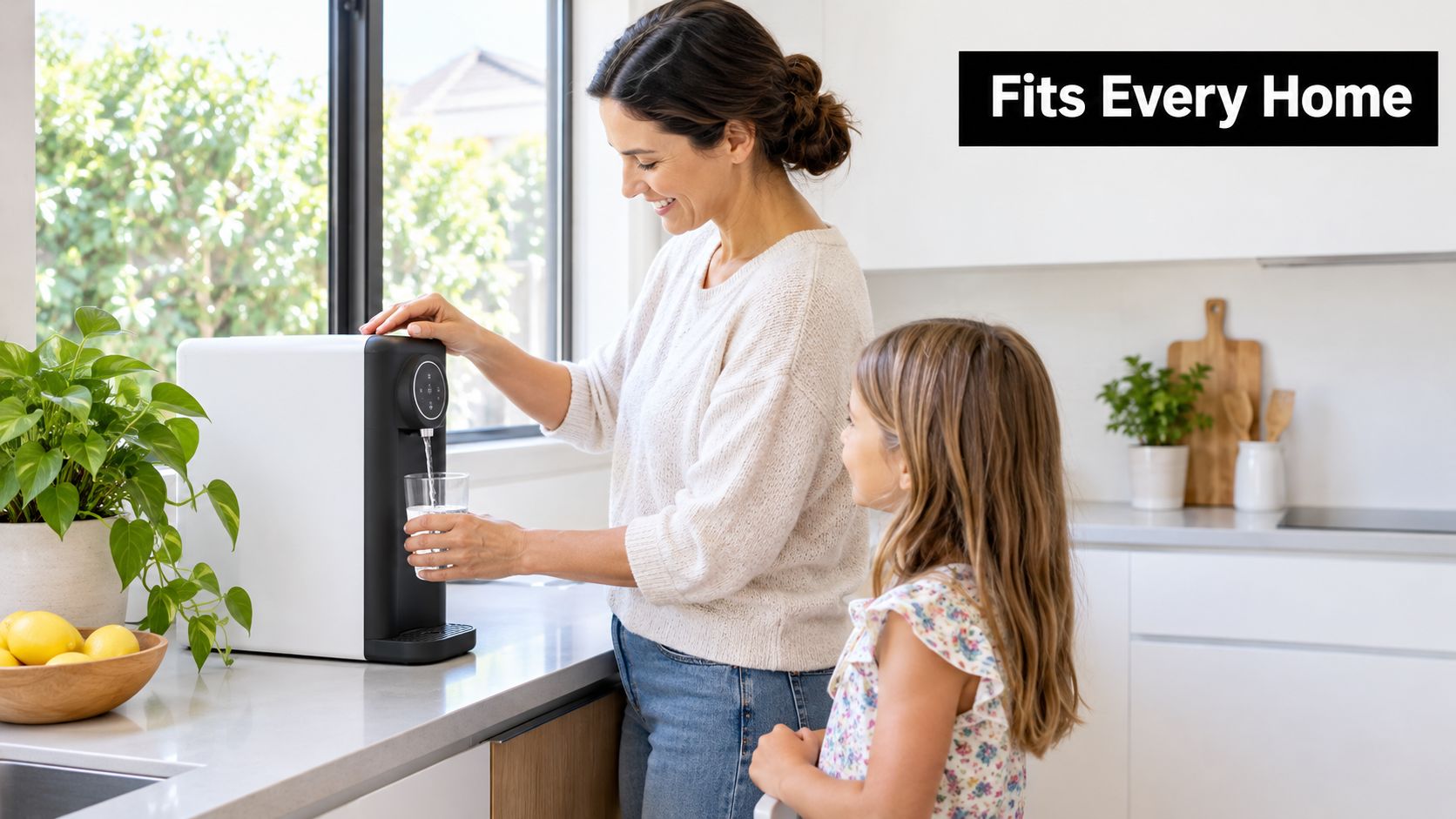
In a Melbourne home, the priorities are usually footprint, safe access, quiet operation and low-effort servicing. An under-sink filter paired with a chilled dispenser or boiling tap can keep the bench clear, while a freestanding cooler suits a household that fills several bottles throughout the day.
Offices and coworking spaces need a different specification. Chilled capacity, recovery time, touchless or low-contact dispensing, simple cartridge access and a clear cleaning responsibility matter more than a long list of optional treatment stages. The unit should sit where people naturally pass, but not where cleaning equipment, bins or food preparation can splash the outlet.
Commercial sites need a written plan, not just a machine. Ring Hot Water's commercial water filtration information is relevant to workplaces and hospitality operators comparing filtration, chillers and service requirements.
Schools and healthcare settings should put accessibility, supervision and hygiene ahead of appearance. Specify controls that users can operate safely, surfaces that staff can disinfect, and service access that doesn't require moving other equipment. Where vulnerable users are present, the site manager should obtain appropriate water-quality and infection-control advice instead of assuming a consumer cartridge addresses every risk.
A café, pub or function room has bursty demand. The system may be quiet for part of the day and then serve many users in a short period, so the important questions concern chilling recovery, outlet flow, drip-tray capacity and cleaning access. A small domestic cooler can be perfectly adequate at home yet frustrating behind a busy service counter.
A useful site survey records the following:
- Demand pattern: steady office use differs from event-driven hospitality use.
- Output temperature: chilled may be the priority, while a kitchen may also need boiling or ambient water.
- Installation route: check the nearest cold-water line, power supply, drainage and access for a licensed plumber.
- Service access: leave room to isolate, sanitise and replace the cartridge without dismantling cabinetry.
The following video offers a visual reference for how dispensing and filtration systems can be integrated into practical settings.
Australian Installation and Compliance Essentials
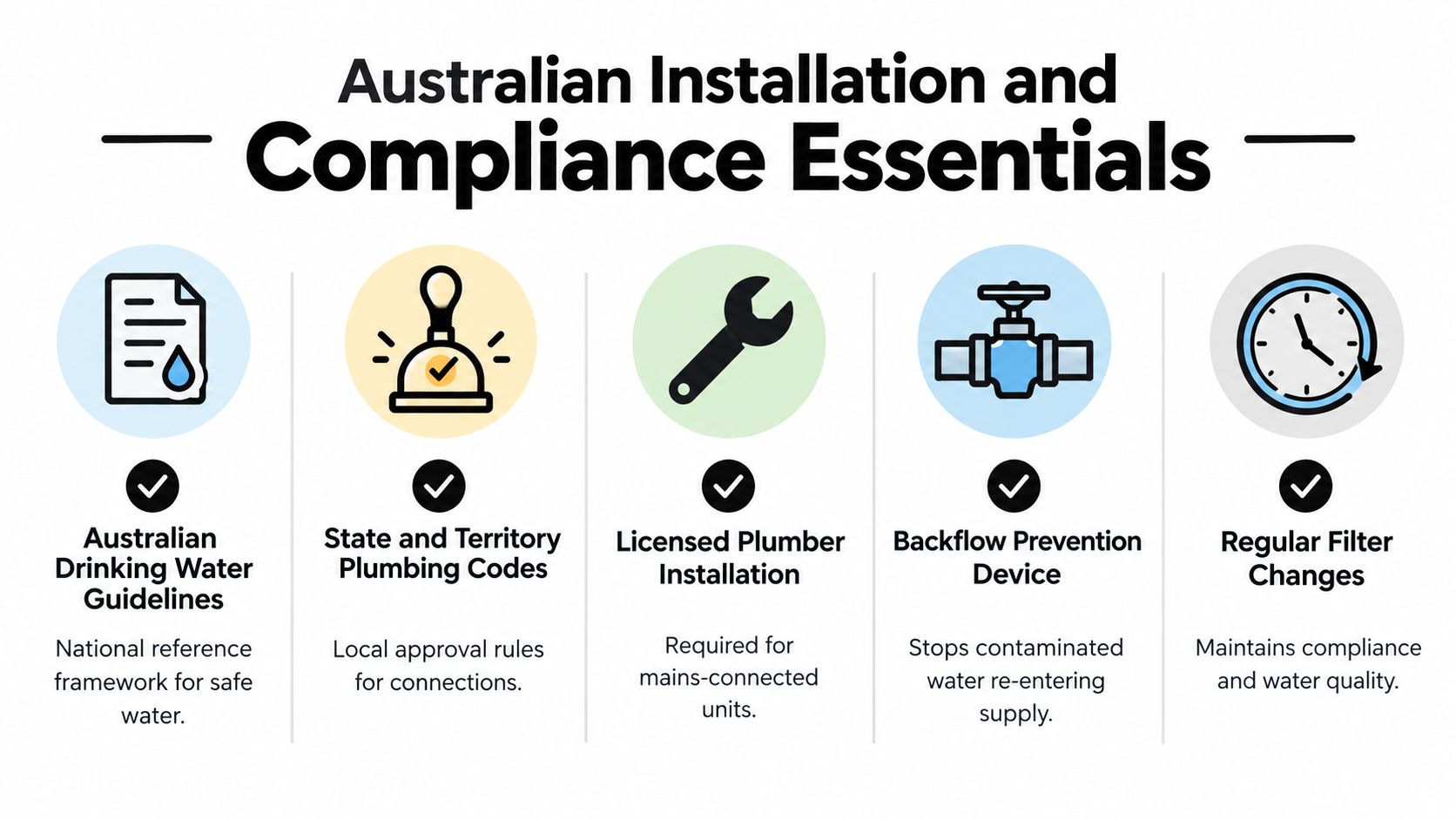
A mains-connected filtered cooler is part of the potable-water system, not just an appliance placed beside a sink. The installation should use components approved for drinking-water contact and comply with the applicable Australian plumbing requirements. The Australian Drinking Water Guidelines provide the national reference framework, while state and territory regulators and plumbing rules govern local connections and approvals.
Lead risk can arise after water leaves the public main. Water that sits against some brass fittings for extended periods can dissolve lead into the water, particularly where components aren't suitable for potable use. That makes material selection and stagnation control important even when the public supply itself is routinely monitored.
Specify the connection properly
Ask the installer to confirm the following before work begins:
- WaterMark certification: Use WaterMark-certified components where certification applies.
- AS/NZS 4020 suitability: Confirm that wetted materials meet the standard for products in contact with drinking water.
- Low-lead or lead-free fittings: Prefer these where possible, especially around the cooler and filter housing.
- Cold-water connection: Connect the unit to the cold-water line, never a hot-water branch.
- Isolation valve: Fit an accessible valve so the cooler can be serviced without shutting down unrelated fixtures.
- Backflow protection: Include the protection required for the installation and local plumbing rules.
A generic filter shouldn't be advertised as removing lead, bacteria, PFAS or dissolved salts unless the exact cartridge and system have independently verified performance for that claim. Activated carbon is principally relevant to chlorine, taste and odour, while sediment stages protect internal parts from particles. The compliance of the plumbing components and the performance of the filter are related but separate questions.
Control stagnant water
A cooler that sits unused still contains water in its internal pathways. Australian enHealth guidance recommends flushing a drinking outlet for at least 10 seconds after overnight stagnation, and for at least two minutes after more than 48 hours without use. For commercial premises closed for longer periods, Australian guidance recommends flushing individual outlets for at least 10 seconds before first use each morning and selected outlets for at least two minutes after closures exceeding seven days. Australian Government guidance on lead in drinking water
Melbourne offices, holiday homes and hospitality venues should write the flushing step into their opening checklist. Record the date, the person responsible and any unusual taste, colour, flow or leak. That simple record makes it easier to identify whether a problem relates to stagnation, a blocked cartridge, a fitting or the incoming supply.
The Honest Case for and Against Extra Filtration
For most Melbourne users on a compliant reticulated supply, filtration is primarily a taste, temperature and convenience upgrade, not proof that the mains water is unsafe. The Water Services Association of Australia says additional home treatment is generally unnecessary for reticulated supplies below the guideline values. Its PFAS guidance also explains that most supplies are already below the relevant limits and that PFAS-related health risk is low for most Australians. WSAA PFAS drinking-water guidance
That position matters because maximum filtration can create its own costs. Reverse osmosis may reduce flow and create wastewater. A complex multi-stage system has more cartridges to replace and more components to maintain. If the actual complaint is chlorine taste, a correctly specified activated-carbon cartridge and reliable chilling may solve it without paying for treatment that the site doesn't need.
What changed with the 2025 PFAS update
NHMRC's updated guidance set health-based drinking-water values of 8 ng/L for PFOS, 30 ng/L for PFHxS, 200 ng/L for PFOA and 1,000 ng/L for PFBS. The review states that most Australian supplies are already below the new limits, while states and territories determine when water providers are expected to meet the revised values. NHMRC's updated Australian Drinking Water Guidelines
Those values don't mean every home or office needs a PFAS-rated cooler cartridge. They mean buyers should stop treating the word “filtered” as a sufficient specification. NHMRC identifies granular activated carbon, ion exchange and reverse osmosis as common PFAS-treatment approaches, but only a cartridge with a verified claim for the relevant PFAS compounds should be selected for that purpose.
Extra treatment deserves closer consideration where:
- the property uses rainwater or a tank supply;
- an independent test identifies a contaminant;
- the local supplier provides relevant water-quality information;
- a workplace has a documented risk-management reason for additional treatment;
- a health professional recommends a particular approach for a specific user.
The sensible process is test, identify, match and maintain. Ask the water supplier for local data, check the exact filter claim and confirm the replacement capacity. Don't buy an expensive membrane because a sales label implies that every contaminant is the same.
Maintenance Routines and a Practical Buying Checklist
A filtered water cooler isn't fit and forget. Set the replacement point using the manufacturer's rated capacity alongside consumption, sediment loading, pressure loss and shutdown periods. Inspect flow and taste, check for leaks, clean the drip tray and dispensing surfaces, sanitise internal water-contact parts as directed, and record the cartridge model, date and installer. A written water-filter servicing routine keeps the responsibility visible.
| Item to verify | Why it matters | What to ask the supplier |
|---|---|---|
| Chilled capacity and recovery | Prevents queues during peak use | Will output suit our busiest period? |
| Exact filter claim | Matches treatment to the actual issue | Which cartridge addresses our documented concern? |
| WaterMark and AS/NZS 4020 suitability | Supports compliant potable-water installation | Which components carry the required approval? |
| Isolation and service access | Makes maintenance safer and faster | Can the valve and housing be reached without major removal? |
| Warranty and spare parts | Reduces downtime | Are genuine cartridges and parts available locally? |
| Melbourne installation coverage | Assigns connection and commissioning to the right trade | Who installs, flushes and records the system? |
Ring Hot Water supplies chilled and filtered drinking-water solutions, including residential and small-office systems, and supports installation, repair, maintenance and replacement parts across Melbourne. Compare the site conditions with the supplier's proposed cartridge and service plan, then arrange a properly commissioned installation rather than choosing on the appliance price alone.
Ring Hot Water can help Melbourne homes, offices and hospitality venues compare chilled, boiling and filtered-water options, then arrange installation, servicing and genuine replacement parts. Visit Ring Hot Water to discuss a filtered water cooler that matches your supply, usage pattern and maintenance requirements.